A list of 100 titles and a set of 100 useful article briefs are different deliverables. You can produce 100 candidate titles quickly, and it is not hard. You cannot produce 100 publishable articles quickly, because most candidates will repeat each other, miss your readers, or have nobody behind them who knows the subject.
This guide uses a matrix to produce candidates in a controlled way, then walks through the filter that turns them into a short list of briefs worth writing. No timing is promised. The candidate step is fast, the filter step is where the effort goes, and no elapsed-time benchmark is claimed.
Why a matrix beats "give me 100 ideas"
Ask a model for 100 blog ideas on a topic and you get a list that repeats itself and drifts toward generic titles. The list is also unaccountable: you cannot tell why any item is there.
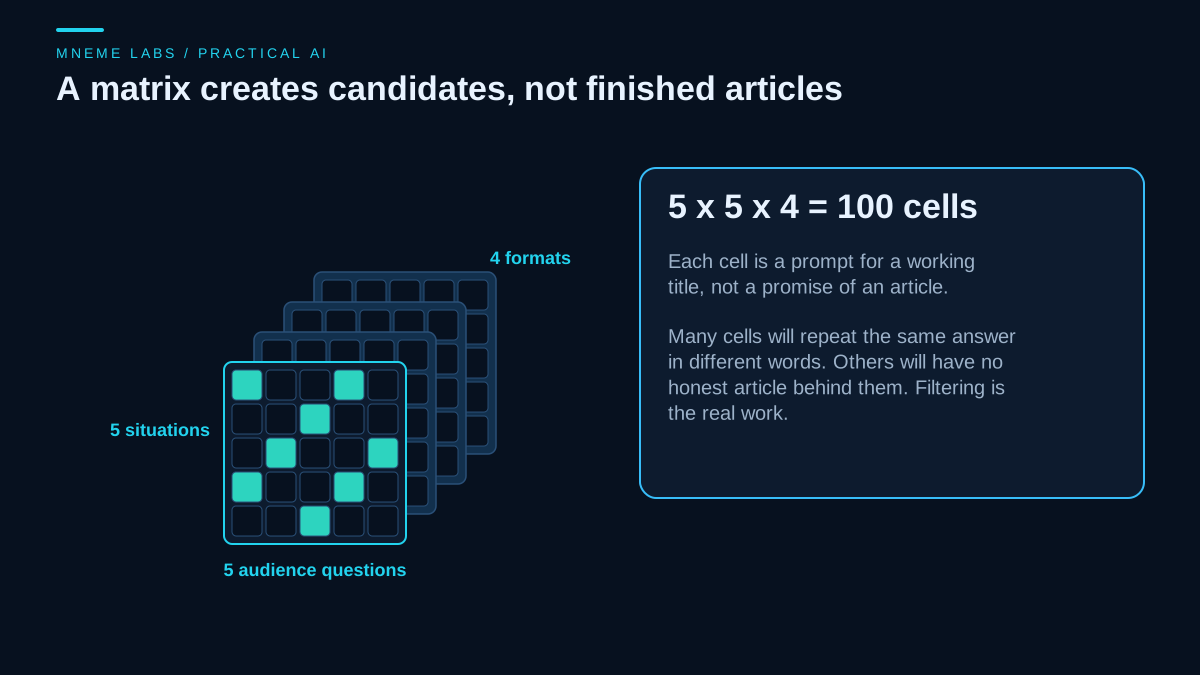
A matrix gives each candidate a reason to exist. You choose the dimensions, so each cell is a specific combination: a question a reader asked, a situation that changes the answer, and a format that suits it. The count comes from arithmetic. Five questions times five situations times four formats is 100 cells.
Build the axes from evidence
The axes decide the quality of everything downstream. Do not ask a model to invent them.
- Audience questions. Pull five real questions from reader emails, comments, or your search query report. Use the reader's wording.
- Situations. Pick five circumstances that change the right answer: where, when, constraints, experience level.
- Formats. Pick four formats that fit your site, such as a troubleshooting checklist, a FAQ, a comparison, or a step-by-step guide.
For a hypothetical home-composting blog, the axes might be:
- Questions: Why does my compost bin smell? Can I compost citrus peels? How long until compost is ready? Do I need worms? Can I compost in winter?
- Situations: apartment balcony, small yard, cold climate, shared household, first month.
- Formats: troubleshooting checklist, FAQ, comparison, step-by-step guide.
Generate the cells in code so the product is exact and none are skipped:
from itertools import product

questions = [
    "Why does my compost bin smell?",
    "Can I compost citrus peels?",
    "How long until compost is ready?",
    "Do I need worms?",
    "Can I compost in winter?",
]
situations = ["apartment balcony", "small yard", "cold climate",
              "shared household", "first month"]
formats = ["troubleshooting checklist", "FAQ", "comparison", "step-by-step guide"]

cells = [
    {"id": f"c{i:03d}", "question": q, "situation": s, "format": f}
    for i, (q, s, f) in enumerate(product(questions, situations, formats), start=1)
]
print(len(cells))  # 100
Running this prints 100 and the first cell is "Why does my compost bin smell?" with "apartment balcony" and "troubleshooting checklist."
Let the model say no
Now ask a model for a working title for each cell, with one important rule: it may decline. Some combinations are not real articles. "Can I compost in winter?" in a "first month" situation as a "comparison" may have no honest reason to exist.
Ask for a structured record per cell, such as viable (true or false), working_title, reason, and needs_evidence. OpenAI's Structured Outputs guide says the feature constrains output to your JSON Schema, and also says your application must handle refusals and incomplete responses and validate business rules the schema does not express. So check that every viable: false row has a reason and that no cell is missing.
A prompt along these lines works as a starting point: "For each cell, write a working title only if a reader with this question in this situation would need a separate page in this format. If the answer would match another cell, set viable to false and name the cell it duplicates."
Three cells from the composting example show what the review looks like:
- Why does my compost bin smell? / apartment balcony / troubleshooting checklist. Viable, if you can say how a balcony changes the fixes. Space, neighbors, and no access to soil are real constraints. If you cannot speak to them, mark it
needs_evidence. - Do I need worms? / cold climate / step-by-step guide. It may overlap the winter question. Compare the required answers first: worm care could need its own evidence and decisions. Merge only when the two briefs would substantially repeat the same answer.
- Can I compost in winter? / first month / comparison. Hold it unless you can name two researched alternatives worth comparing. Without them, return
viable: falseand explain the missing comparison.
Reading the reasons the model gives for false rows is useful on its own. They show which axes are weak and which questions are really the same question.
Filter in order
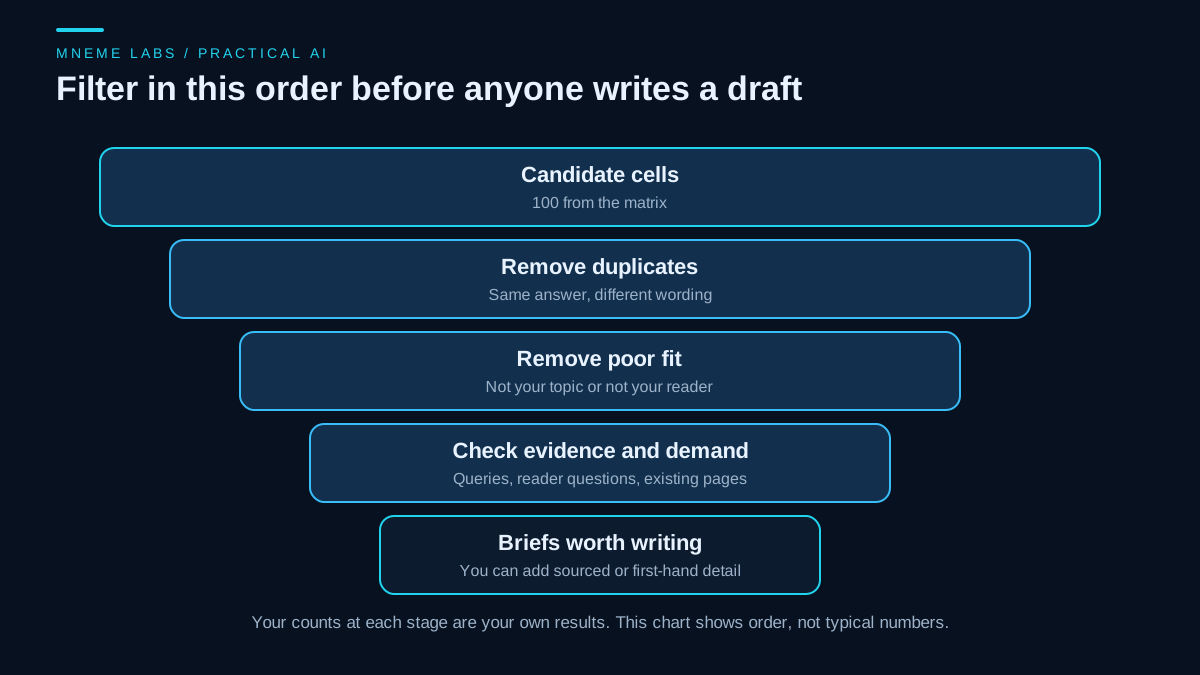
Sort out the candidates in the order shown above, cheapest check first.
1. Remove duplicates. In the composting example, "Can I compost citrus peels?" crossed with five situations gives questions that mostly share one answer. Group cells by the question they answer, not by their wording.
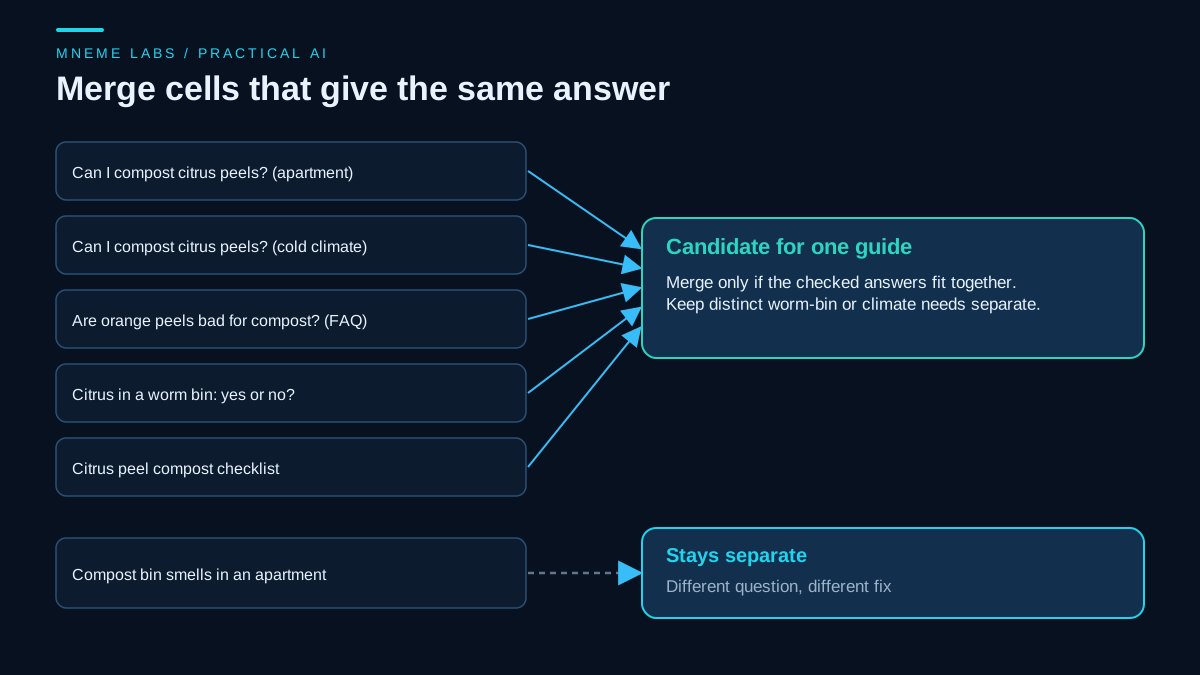
2. Remove poor fit. Drop anything outside the site's topic or beyond what you can speak to. A page you cannot add anything to will repeat what is already available.
3. Check evidence and demand. Compare survivors with your search query data and reader messages. Google's Performance report shows the queries your pages already appear for, with impressions and clicks. That helps you see whether a question appears in your own data or only in the model's imagination. A candidate with no evidence is not dead, but it needs a reason beyond "the matrix produced it."
4. Keep briefs, not titles. For each survivor, write a short brief: the reader's question, what you will say that other pages do not, the sources you will cite, and an existing page it links to.
The risk of mass-produced pages
A 100-cell matrix can tempt you to publish all of them. Google's spam policies describe scaled content abuse as creating many pages primarily to manipulate rankings, including using generative AI to produce many pages without adding value for users. The same page defines doorway abuse as creating substantially similar pages that are closer to search results than to a clearly organized site. Cells that differ only by a swapped situation word are the pattern that definition describes.
Google's people-first content guidance asks the right questions here: are you producing lots of content on many topics hoping some will perform, are you using extensive automation to produce content on many topics, and would your readers find it useful if they came to you directly? And its page on generative AI content says AI can help with research and structure, and that accuracy and review matter. If a model suggests the idea, a person still has to supply the substance.
Failure modes
- Axes copied from a model. You end up with generic combinations. Use real questions.
- Cross-product nonsense. Some combinations are impossible or silly. Allow
viable: false. - Near-duplicates survive. A wording check misses paraphrases. Group by the question answered.
- Format for its own sake. A comparison needs two things worth comparing.
- Evidence skipped. Candidates that never touch your data tend to be guesses.
- Everything published. Most of the matrix should end as notes inside other articles or as nothing.
Limits
This method produces candidates, not demand. It cannot tell you whether a topic will draw readers, and the 5 x 5 x 4 shape is only an example. A smaller site might use three questions and three situations. The composting axes here are invented for illustration, and no filter yields are claimed.
Next step
Choose your three axes from real material, build the cells, and run the filter in order. Write down how many cells survive each stage, because that is your own data about how loose or tight your axes are. Then put the survivors into the backlog described in the content idea backlog guide, and use the audience research guide to turn evidence into tests. When a brief is approved, the drafting workflow covers the writing.
Sources
- Google Search Central, Spam policies for Google web search
- Google Search Central, Creating helpful, reliable, people-first content
- Google Search Central, Guidance on using generative AI content
- Google Search Console Help, Performance report (Search results)
- OpenAI, Structured Outputs
Images are original Mneme Labs diagrams.