A promise to write every article ten times faster ignores where the work happens. How long a post takes depends on the topic, how much you already know, how good your sources are, and how much of the draft you keep. A useful speed estimate needs measurements from your own writing and review process.
What can be described is a workflow that puts the model where it helps and keeps people where mistakes cost the most. The helpful part is turning organized material into readable sentences. The costly part is a claim that sounds right and is not. This guide is about drafting and editing, which is a different job from deciding what to write. For that, see the idea backlog guide and the matrix filter guide.
Why drafting is a different problem from ideation
Ideation asks whether a topic deserves a page. Drafting asks whether the page, once written, is accurate, complete, and useful to the person reading it. A model can produce fluent paragraphs on either. Fluency does not tell you which paragraphs are true.
Google's guidance on generative AI content puts the problem plainly: generated prose can contain inaccuracies even when it reads fluently. The page says it is critical to manually fact-check and review AI-generated content before publishing, and that this review applies to titles, meta descriptions, structured data, and image alt text as well as the body. That sets the standard for the rest of this guide.
A worked example: a hypothetical post on seasoning cast iron
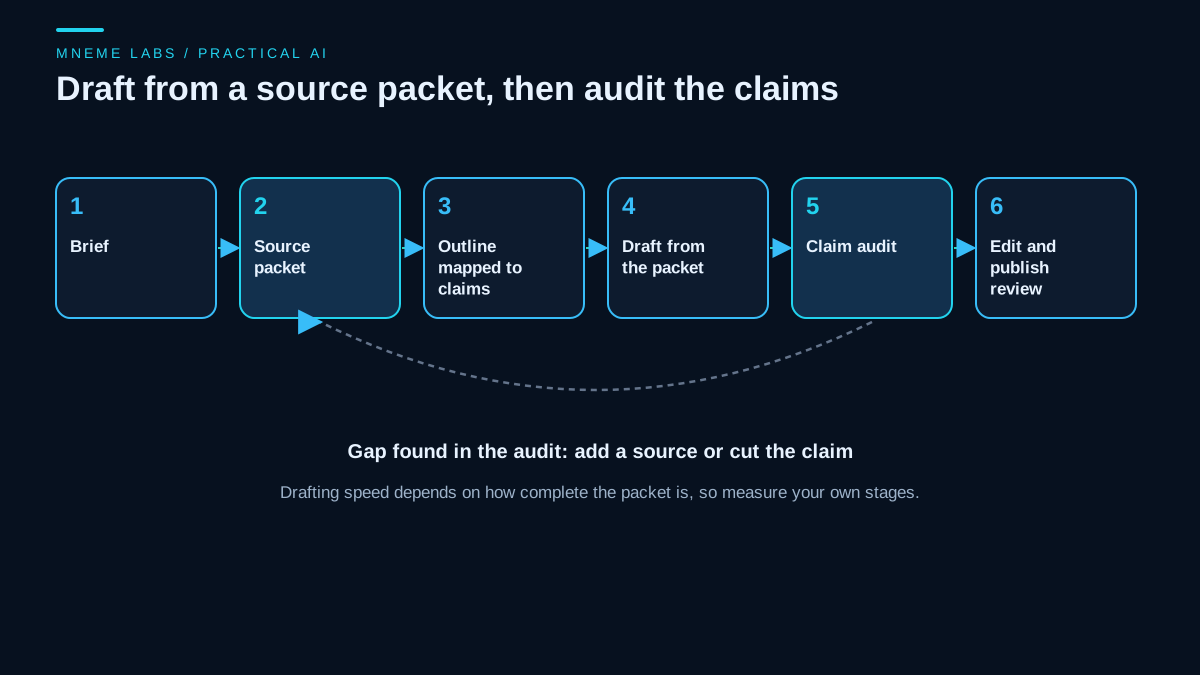
Suppose you want to publish "How to season a cast iron skillet." You have cooked on cast iron for years, but you also want the method steps to be right. The workflow has six stages.
1. Write the brief
Two or three sentences: who the reader is, the question, and what they should be able to do afterward. Add what you know first-hand. For this post: "Reader has a new or rusty skillet and wants a surface that cooks without sticking. I can speak to sticky surfaces from my own use. Method details need a source."
2. Build a source packet
Collect the material the draft is allowed to use: the manufacturer's instructions for your pan, a university extension or food-safety page if you cite one, your own cooking notes, and anything a reader told you. Save the relevant passages, not only links. Mark your own notes as first-hand.
The packet is the model's whole world for this post. If it is thin, the draft will be thin or invented.
3. Outline against claims
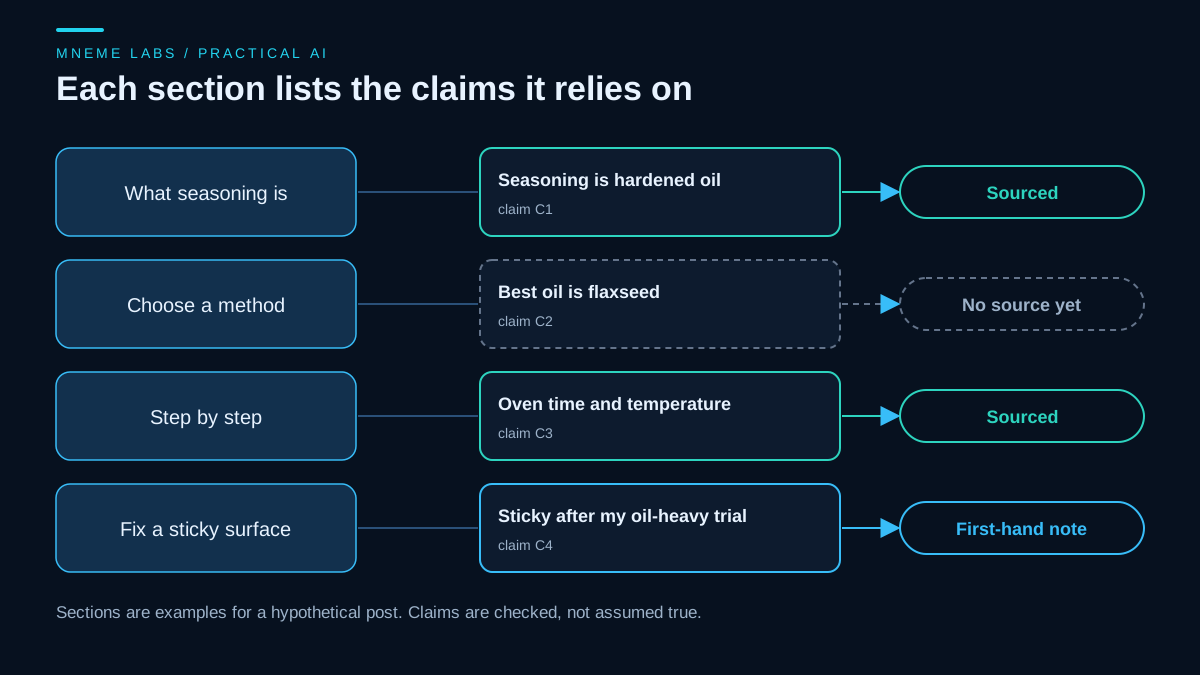
For each section, list the claims it needs. A claim is any statement a reader might act on: a temperature, a time, a rule ("never use soap"), a number ("three coats"), a cause ("sticky means too much oil"). Next to each, note whether it is sourced, first-hand, or unsupported. The first diagram shows this map. Unsupported claims either get a source in the next pass or get cut.
4. Draft section by section from the packet
Draft one section at a time, with instructions that limit the model to the packet. A prompt might read:
Use only the source packet below. Write the section "Step by step" for a
beginner. After each factual sentence, add the packet item that supports it,
like [P3]. If the packet does not support a statement you would normally
include, write "NEEDS SOURCE" instead of the statement. Do not add numbers,
temperatures, times, or brand names that are not in the packet.
Anthropic's guide to reducing hallucinations supports each part of that prompt. It recommends allowing the model to say it does not know, extracting word-for-word quotes before analysis for long documents, and requiring the model to find a supporting quote for each claim and remove any it cannot support. It also says these techniques reduce hallucinations but do not eliminate them, and that critical information should still be validated.
Drafting section by section keeps the packet small and makes errors easier to trace. It makes a missing source easier to notice; the model can still invent material, so the claim audit remains necessary.
5. Audit the claims
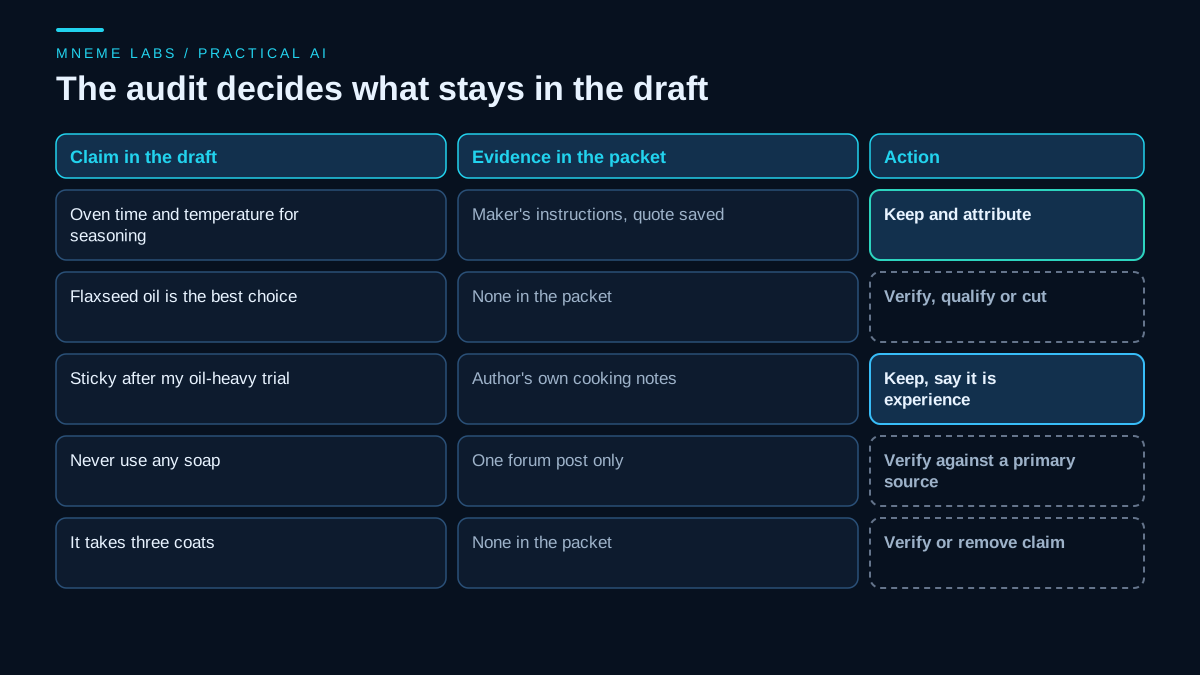
Pull every claim from the draft into a table and record the evidence. This is a human task, though a model can list the claims for you to check. For the example post, it might look like this:
- Oven time and temperature for seasoning. Evidence: manufacturer's instructions, quote saved. Action: keep and attribute to the maker.
- Flaxseed oil is the best choice. Evidence: none in the packet. Action: cut unless you have a genuine, clearly explained personal preference to report. Do not relabel an invented factual claim as opinion.
- A sticky surface means too much oil. Evidence: your own cooking notes. Action: keep, and say it is your experience.
- Never use any soap. Evidence: one forum post. Action: verify with a primary source or remove. Softer wording does not make a false instruction accurate.
- It takes three coats. Evidence: none. Action: find the applicable manufacturer procedure or remove the instruction; an unverified number should not become an unverified vague step.
If you want the model's help, run the same draft through a second pass that must find a quote for each claim, and compare the result with your table. Anthropic's guide also suggests running the same prompt several times and comparing outputs, since inconsistencies can signal a hallucination. Treat disagreement as a prompt to look, not as an answer.
6. Edit for voice, specificity, and what to leave out
Only now edit for style. Replace generic sentences with specifics from your notes. Cut the paragraph that explains what a skillet is. Read it aloud. Make sure the first-hand parts sound like you, because the model cannot know your experience. Keep a short style sheet with examples from your own writing. Use it to check vocabulary and rhythm after the evidence review, rather than asking the model to invent a personal experience.
Do not copy your sources
A packet full of excerpts invites paraphrase that stays too close to the original. Google's people-first content guidance asks whether content that draws on other sources avoids simply copying or rewriting them and adds substantial value, and whether it provides original analysis beyond the obvious. The same page asks whether the content shows first-hand expertise, for example from having actually used a product. Use sources to check facts and cite them, then write in your own words from your own understanding.
Do not scale this into a content mill
A faster process makes it easy to publish more pages than you can stand behind. Google's spam policies name scaled content abuse, which includes using generative AI tools to generate many pages without adding value for users. The audit stage is partly there to slow you down at the right place.
Measure it yourself
If you want to know whether this saves time, record minutes per stage for your next three posts: brief, packet, outline, draft, audit, edit. Note how many claims the audit removed or changed. After three posts you will have your own numbers, and you can see whether the packet or the audit is your bottleneck. Nothing here depends on a particular speedup.
Failure modes
- Thin packet, confident draft. The model fills gaps with plausible text. A "NEEDS SOURCE" instruction asks the model to expose gaps; the reviewer still has to catch unsupported claims it failed to flag.
- Fake citations. If a source is in the draft but not in your packet, assume it is invented until you open it.
- Audit skipped because the prose reads well. Fluent text lowers your guard.
- Voice flattening. Heavy rewriting from a model can erase the first-hand detail that makes the post worth reading.
- Metadata left unchecked. Titles, descriptions, and alt text are generated text too.
Limits
The cast iron example is hypothetical, and nothing in it is a recommendation about seasoning. Safety-related advice, such as food, health, electrical work, or legal topics, deserves review by someone qualified, not just by you and a model. The workflow lowers the odds of publishing an unsupported claim. It does not remove them.
Next step
Take a post you are about to write and build only the packet and the claim list. If you cannot fill the packet, the topic may belong in your backlog until you can. For the reader-research side of planning, see the audience research guide, and for a bounded first project with the same review habits, the first agent tutorial.
Sources
- Google Search Central, Guidance on using generative AI content
- Google Search Central, Creating helpful, reliable, people-first content
- Google Search Central, Spam policies for Google web search
- Anthropic, Reduce hallucinations
Images are original Mneme Labs diagrams.