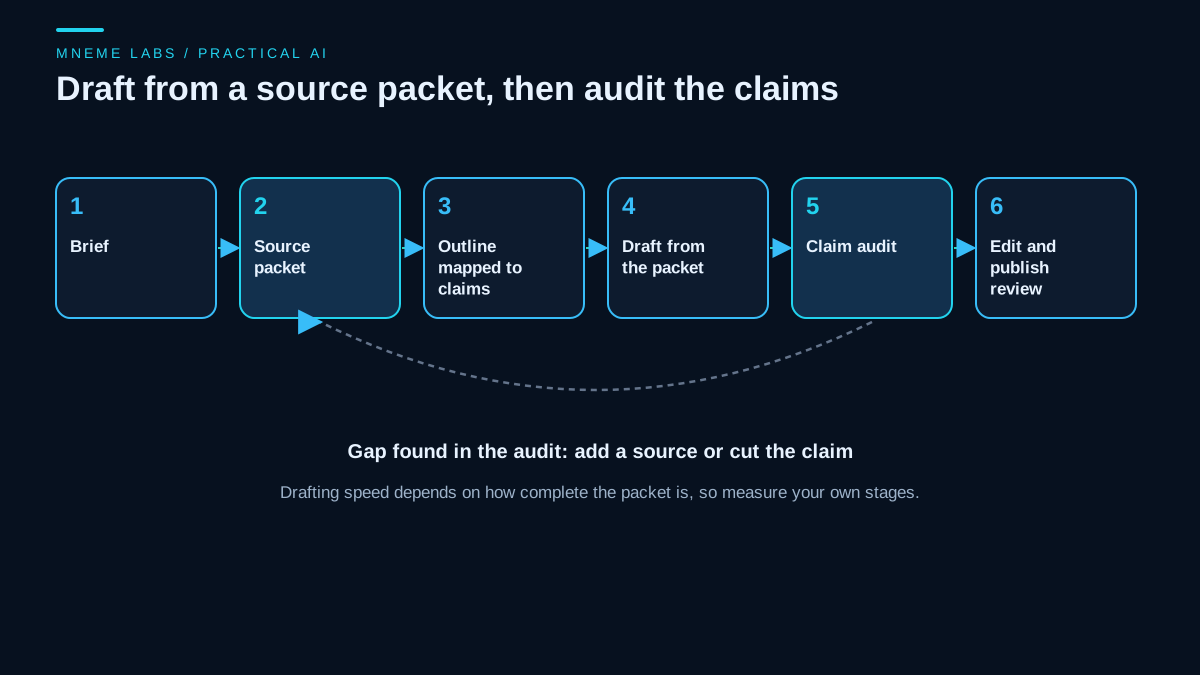
Some advice about making AI text sound human is about disguise: swap a few words, add contractions, sprinkle in "I think". That treats the problem as surface style, and it invites a worse habit, which is adding invented personal stories so the text seems real. A draft that reads as lifeless is usually lacking two things. It has no evidence behind its claims, and it has nothing specific that only the author could say.
This guide is about editing for those two things first and polishing the voice after. It includes a small lint that finds stock phrases and rhythm patterns. The lint is a prompt for an editor, not a measure of quality, and it cannot tell who or what wrote a piece of text. The sample text is synthetic, and no claim is made about engagement or rankings. For the drafting side, see the source-first drafting guide.
What "robotic" usually means
When readers call a text robotic, they usually react to a handful of things.
- Generic claims. "Content is important for every business" could appear on a thousand pages. It tells the reader nothing.
- Stock phrases. "In today's digital landscape" and "in conclusion" fill space and signal that nobody thought about the sentence.
- Repeated structure. Three sentences in a row that begin with "Furthermore" read like a template.
- Even rhythm. Sentences of nearly the same length make a flat sound.
- No evidence. A number with no source, or advice with no example, asks the reader to trust the text blindly.
- No stake. The text takes no position, so it could be about anything.
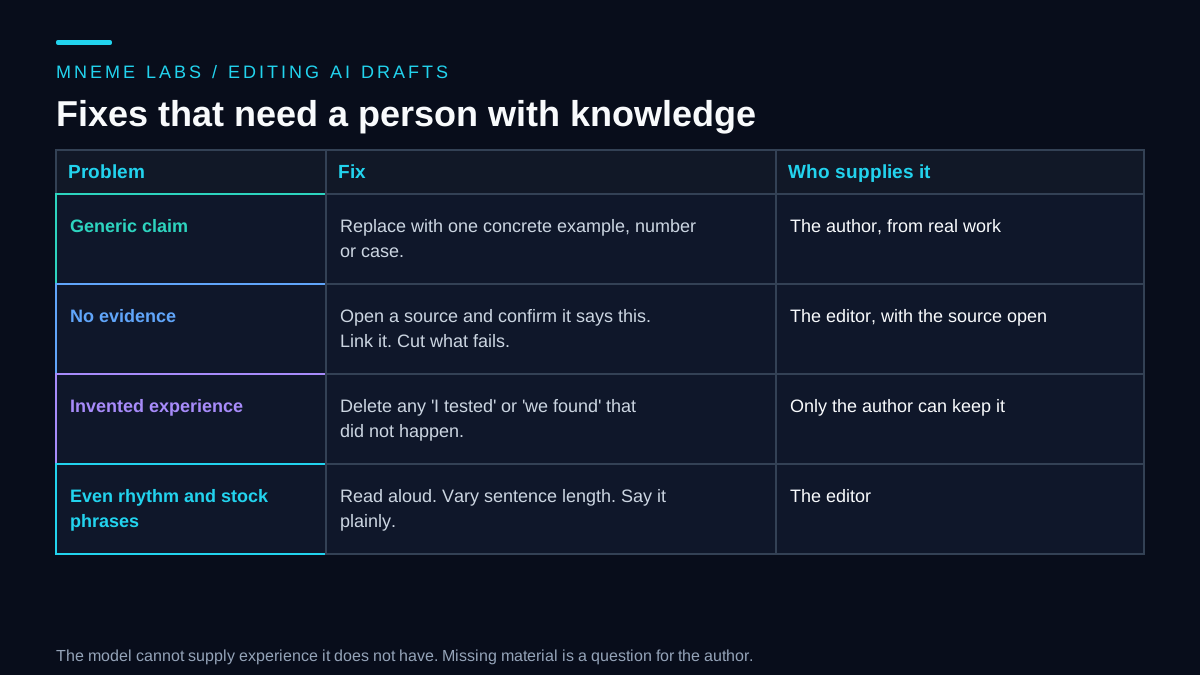
The first and fifth are the hard ones. You can fix stock phrases in a minute. A generic claim needs a real example, and an unsupported number needs a source. A model cannot invent those honestly.
Why not just make it sound human
Disguise has a cost. If you ask a model to add "personal examples" and "emotional reactions" without supplying real notes, it may invent events that never happened. A reader who discovers a fabricated story has reason to distrust the rest. In some settings, such as consumer reviews and testimonials, invented experience can also be a legal problem. The US rule at 16 CFR 465.2 prohibits businesses from creating or selling reviews or testimonials that materially misrepresent the reviewer's existence, experience or use of the product. Its scope is specific; other legal duties may apply elsewhere. Honest sourcing matters even when no particular testimonial rule applies.
Search engines are not the target either. Google's guidance on AI-generated content says its ranking systems aim to reward original, high-quality content that demonstrates experience, expertise, authoritativeness and trustworthiness, and that its focus is on the quality of content rather than how it is produced. It also says that using automation, including AI, to generate content with the primary purpose of manipulating search ranking violates its spam policies, and that not all use of automation is spam. Its spam policies describe scaled content abuse as generating many pages primarily to manipulate rankings with little value for users, however they are made. So the question to ask of a draft is whether it helps a reader, not whether it hides how it was written.
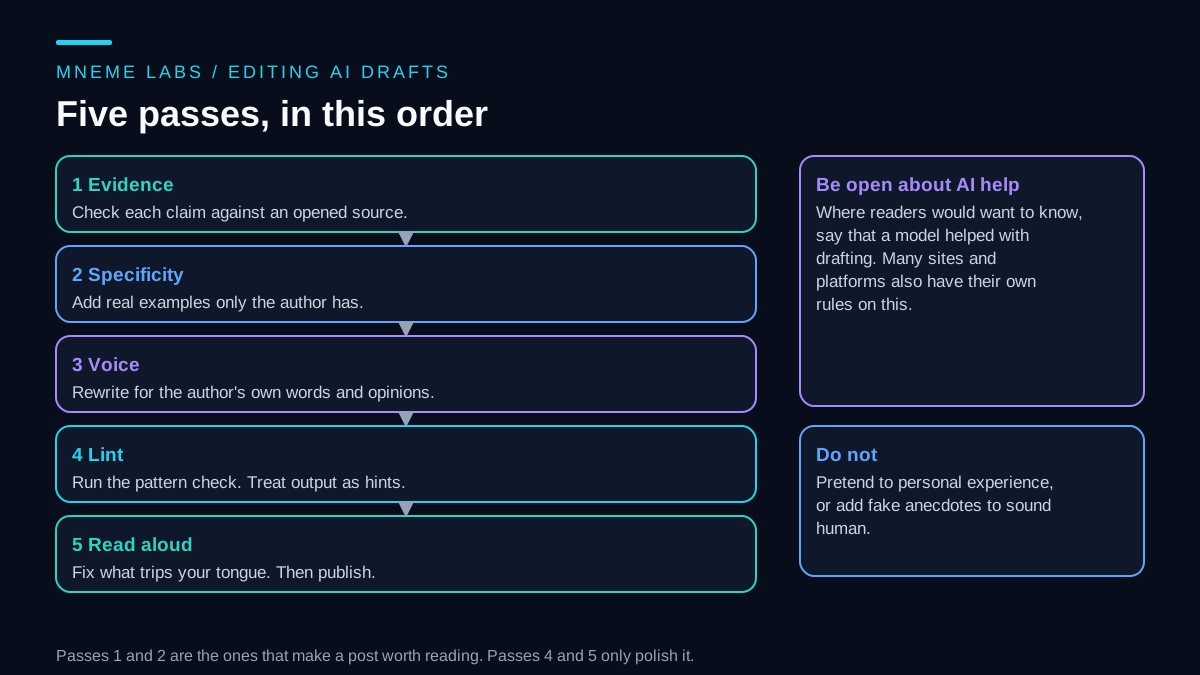
Edit in this order
The order matters because the early passes decide what is left to polish.
1. Evidence pass. List each factual claim and number. Open a source for each and confirm that it says what the draft says. Link the source near the claim, and cut or rewrite anything that fails. The people-first content guidance asks whether content shows clear sourcing, evidence of the expertise involved and background about the author, and whether it provides original information, reporting, research or analysis. A draft that passes this pass already sounds less generic, because specific sourced statements replace vague ones.
2. Specificity pass. Find the sentences that could apply to anyone. For each, ask the author for one concrete thing: a case, a number from their own work, a mistake, a decision and the reason for it. If the author has nothing real to add, shorten the section. A short, honest section beats a long invented one.
3. Voice pass. Now rewrite for the author's own words. Give the model two or three paragraphs the author wrote, and ask it to point out where the draft differs in vocabulary and sentence length. Then edit by hand. A model can suggest, but the person who owns the byline decides what they would say.
4. Lint pass. Run a pattern check, covered next.
5. Read-aloud pass. Read the text out loud, and fix what trips your tongue. This catches stiff phrasing that no pattern list finds.
A small lint, and what it cannot do
The Python below checks for five patterns: stock phrases, an opening word repeated three or more times, very even sentence lengths, sentences with numbers and no sign of a source, and first-person experience claims that the author should confirm. It is standard-library code, and the phrase list is yours to change.
import re
import statistics

STOCK_PHRASES = ("in today's digital landscape", "it is important to note", "in conclusion", "furthermore",
                 "moreover", "game-changer", "unlock the power", "at the end of the day", "in the ever-evolving")
EXPERIENCE = re.compile(r"\b(?:I|we)\s+(?:tested|tried|used|built|ran|measured|interviewed|helped|worked|found|learned|launched|wrote|saw)\b", re.I)
SOURCE_HINT = re.compile(r"https?://|according to|\bsource\b|\(\d{4}\)", re.I)


def sentences(text):
    return [s.strip() for s in re.split(r"(?<=[.!?])\s+", text.strip()) if s.strip()]


def lint(text):
    out = []
    low = text.lower()
    for phrase in STOCK_PHRASES:
        if phrase in low:
            out.append(("stock_phrase", phrase))
    sents = sentences(text)
    openers = {}
    for s in sents:
        w = re.sub(r"[^a-z']", "", s.split()[0].lower())
        openers[w] = openers.get(w, 0) + 1
    for w, n in openers.items():
        if n >= 3 and w:
            out.append(("repeated_opener", f"{w} x{n}"))
    lengths = [len(s.split()) for s in sents]
    if len(lengths) >= 5 and statistics.mean(lengths) > 0:
        if statistics.pstdev(lengths) / statistics.mean(lengths) < 0.25:
            out.append(("uniform_rhythm", f"lengths {lengths}"))
    for s in sents:
        if re.search(r"\d", s) and not SOURCE_HINT.search(s):
            out.append(("number_without_source", s))
        if EXPERIENCE.search(s):
            out.append(("confirm_experience_claim", s))
    return out
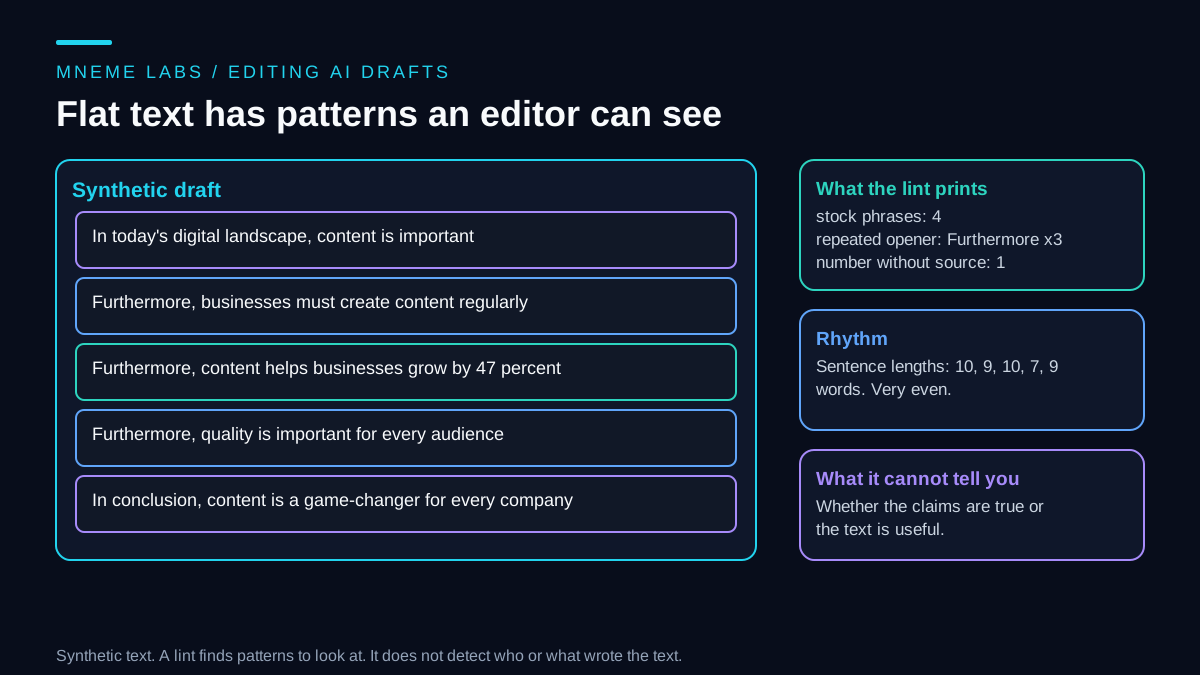
On a synthetic five-sentence flat draft, the lint reported four stock phrases, "furthermore" opening three sentences, sentence lengths of 10, 9, 10, 7 and 9 words, and one sentence with a number and no source. On a rewritten version that names a specific situation and varies its rhythm, it reported nothing. The test file also checks that "I tested the form with five readers." and "Last month I helped a client." are flagged for the author to confirm, that a sentence beginning "According to the 2024 report" with a number is not flagged, and that empty input returns nothing. All checks passed.
The experience check is narrow on purpose, and it will miss claims phrased differently. It matches only "I" or "we" followed directly by one of fourteen verbs: tested, tried, used, built, ran, measured, interviewed, helped, worked, found, learned, launched, wrote and saw. It does not match "I've helped", "I once helped", "my client", "our team" or "when I was at a large retailer". Treat the lint as a first pass, and also search the draft by hand for "I", "we", "my", "our" and "us" and confirm that each personal claim is true. It will also flag true statements, since "I found" is only a prompt to check.
Treat a clean lint result with suspicion. A text can pass every pattern and still be wrong, dull or empty. The thresholds, such as three repeated openers or a length spread under 25 percent, are arbitrary starting points. The lint also cannot say whether a human or a model wrote the text, and you should not use it for that, since a careful human writer can trigger it and a model can be prompted around it. Its only job is to point an editor at places to look.
Be open about AI help where it matters
Readers may want to know when a model helped with a draft, and some publishers, schools and platforms require it. Decide on a practice and apply it consistently: a short note where the text is substantially AI-drafted, or an editorial policy page that describes how you use AI and who reviews the output. Do not claim a text is entirely your own work if it is not. Rules differ by place and by platform, so check them where you publish.
Failure cases to plan for
Invented anecdotes. The model writes "last month I helped a client" and the author never did. The lint flags that exact sentence, but not every phrasing, so search drafts for first-person experience claims and confirm each. Do the search by hand as well as with the lint.
Over-editing into sameness. If every post is run through the same prompt and the same fixes, they converge on one style. Keep the author's own writing as the reference.
Fixing the lint, not the text. Replacing "furthermore" with "also" three times leaves the same flat structure. Rewrite the sentence.
Facts changed during polish. A voice rewrite can alter a number or a claim. Run the evidence pass again on the final text, or compare the numbers before and after.
Hiding thin content. A better voice does not rescue a post that has nothing to say. If pass two finds nothing real to add, merge the post into a better one or do not publish it.
Detector chasing. Rewriting to fool a classifier wastes time and encourages the disguise this guide argues against.
Limits
An editing process cannot make weak ideas strong or give an author experience they lack. The lint finds only the patterns in its list, which reflect English-language drafting habits and one author's judgment. It says nothing about accuracy, tone or usefulness. The Google sources describe what its systems aim to reward and make no promise about where any page will appear. Policies on AI disclosure change often, so check current rules for your own channels.
Next step
Take one recent draft and do passes one and two only. List its claims and sources, and ask the author for one real example per section. Only then run the lint and read the text aloud. Keep a note of what passes one and two found, since the same gaps will recur and are the best material for your next brief to a model.
Sources
- Google Search Central, Google Search and AI-generated content: quality over production method, E-E-A-T, and automation used mainly to manipulate rankings as a spam policy violation.
- Google Search Central, Creating helpful, reliable, people-first content: questions on original information, sourcing, author background and first-hand expertise.
- Google Search Central, Spam policies: scaled content abuse definition and examples.
- 16 CFR 465.2: fake or misrepresented testimonials are unfair or deceptive.