A personal brand is what people conclude about your work when they find you. They may land on a profile, a post, a newsletter or a site, and if those places tell different stories, they will not know which to believe. AI can speed up the writing. It cannot supply the thing a brand rests on, which is evidence that you did what you say you do.
This guide builds a brand from the evidence outward. It starts with a positioning statement, then a log of real work that backs it up, then a way to keep every profile consistent, and finally a monthly loop in which a model drafts and you decide. The example is a made-up freelance bookkeeper who serves small clinics, and everything about her is synthetic. There are no follower promises or income claims here, because audience and income depend on far more than a good system.
Write a positioning statement you can defend
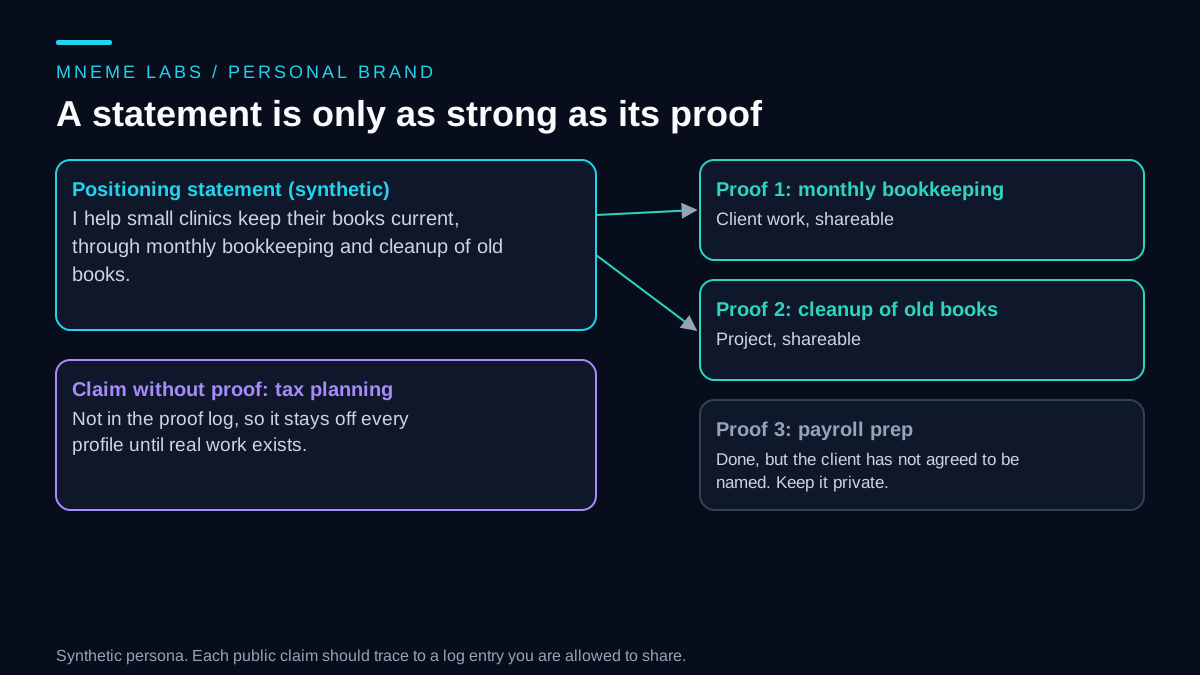
A positioning statement says who you help, with what, and how. A working template is: "I help [a specific group] with [a specific problem] through [what you do]." For the example, it reads: "I help small clinics keep their books current through monthly bookkeeping and cleanup of old books."
Test it with three questions. Could someone in that group recognize themselves in it? Is each part something you have really done? And could you point to at least one example behind each part? If the third answer is no, the statement is ahead of your experience, and you have two honest options. Narrow the statement to what you can show, or do the work and add it later. A model can offer wording variations, but it should not be allowed to add a service, a credential or a number that you did not give it.
Keep a proof log
A proof log is a plain list of real work, kept as you go. For each entry, record the date, the problem, what you did, what happened if you know, which service it counts toward, and whether you may share it. That last field matters. Clients often have not agreed to be named, and details of their business may be confidential. Do not publish what you are not cleared to share, and note the reason in the log.
The log does three jobs. It is the source for posts, case descriptions and bio lines. It limits what a model may write, since you tell it to use only the entries you provide. And it gives you the answer when someone asks, "What have you done in this area?"
Be honest about results. If you know a measurable outcome, say it as it was, including its limits. If you do not know the outcome, write what you did and do not guess at what it achieved. Fabricated testimonials and invented customers are not only a trust problem. The US Federal Trade Commission's rule at 16 CFR 465.2 says it is an unfair or deceptive practice for a business to write, create or sell a consumer testimonial that materially misrepresents that the person exists, that they used the business, or what their experience was. That rule is about businesses and consumer testimonials, and it is US-specific. The principle carries well beyond it: quote real people, with their permission, in their words.
Let AI draft from the log, and only from the log
Once the log has entries, a model is useful. Give it one entry and ask for a short post in plain words that says what the problem was, what you did, and what a reader could take from it. Give it several entries and ask for three bio variants of different lengths. Give it your past writing and ask where a new draft sounds unlike you.
Two guardrails keep this safe. First, tell the model to use only the facts in the entry, and to ask when something is missing. Second, read every draft against the log before you publish. A model will happily add "over eight years" or "trusted by clinics across the country" if the surrounding text invites it. A line that sounds fine and is not in the log is the main risk of this workflow.
Google's guidance on creating helpful, reliable, people-first content lists questions worth asking about your own pages. It asks whether content shows first-hand expertise, such as from having actually used a product or service, whether it offers original information or analysis, and whether it provides clear sourcing and background about the author, for example through an author page or an About page. It also treats extensive automation producing content on many topics as a warning sign. Those questions describe a good personal site as well as a good search result. An About page that states who you are and what you have done, and posts that draw on your own work, answer them directly. A flood of generic posts does not.
Check your profiles against each other
Over time you may end up with a handful of places that describe you: a site, a professional network profile, a newsletter, maybe a few more. They drift apart. One profile says six years of experience and another says eight. One lists a service you stopped offering.
The Python sketch below compares synthetic profiles and flags two things. It reports fields that differ across profiles, and services that appear on a profile without a shareable entry in the proof log.
def audit_profiles(profiles: dict, proof_log: list) -> dict:
    """profiles: {name: {"headline": str, "years": int, "services": set}}.
    proof_log: [{"service": str, "can_share": bool}, ...] from real work."""
    report = {"mismatches": {}, "unsupported_services": {}}
    for field in ("headline", "years"):
        values = {name: p[field] for name, p in profiles.items()}
        if len(set(values.values())) > 1:
            report["mismatches"][field] = values
    proven = {item["service"] for item in proof_log if item["can_share"]}
    for name, p in profiles.items():
        missing = sorted(p["services"] - proven)
        if missing:
            report["unsupported_services"][name] = missing
    return report
Run on three made-up profiles, it reported a headline mismatch on the newsletter, a years mismatch of 6, 8 and 6, payroll prep on the site with no shareable proof, and tax planning on the professional profile with no proof at all. A clean pair of profiles returned empty results. The assertions in the test file confirm each of those outcomes and passed.
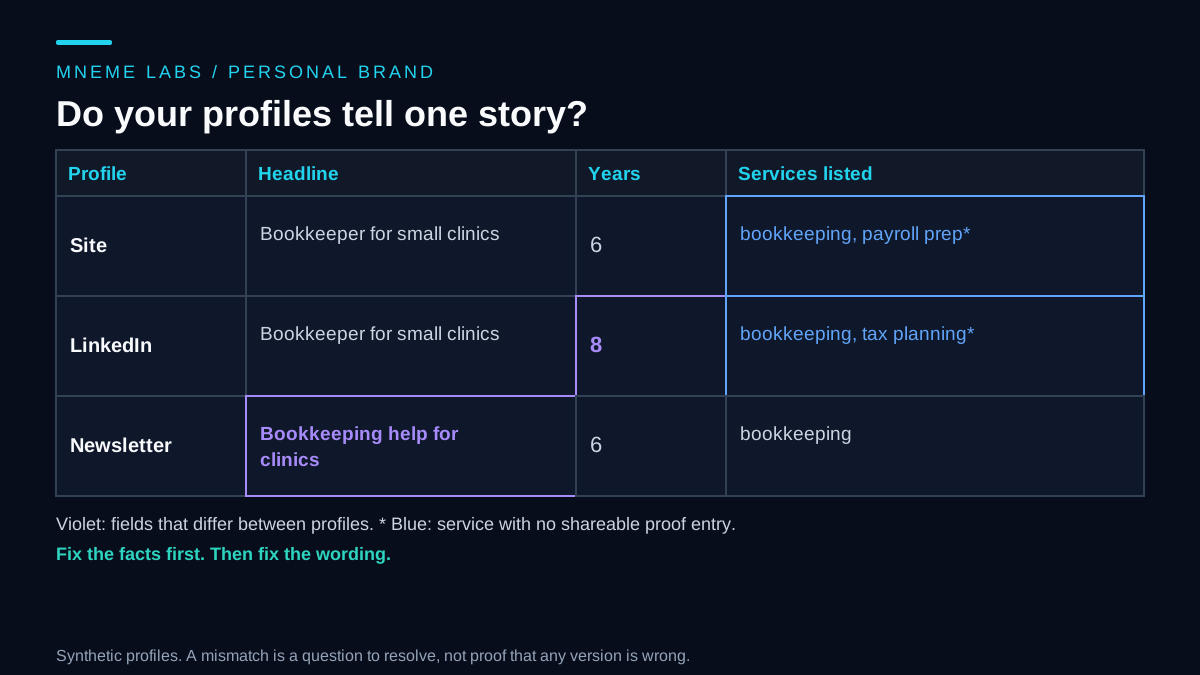
The check finds differences. It does not tell you which version is right. Decide the facts first, then update every profile to match. Run it again whenever you change a profile, and put a date on the log entry that settled each fact.
A monthly loop
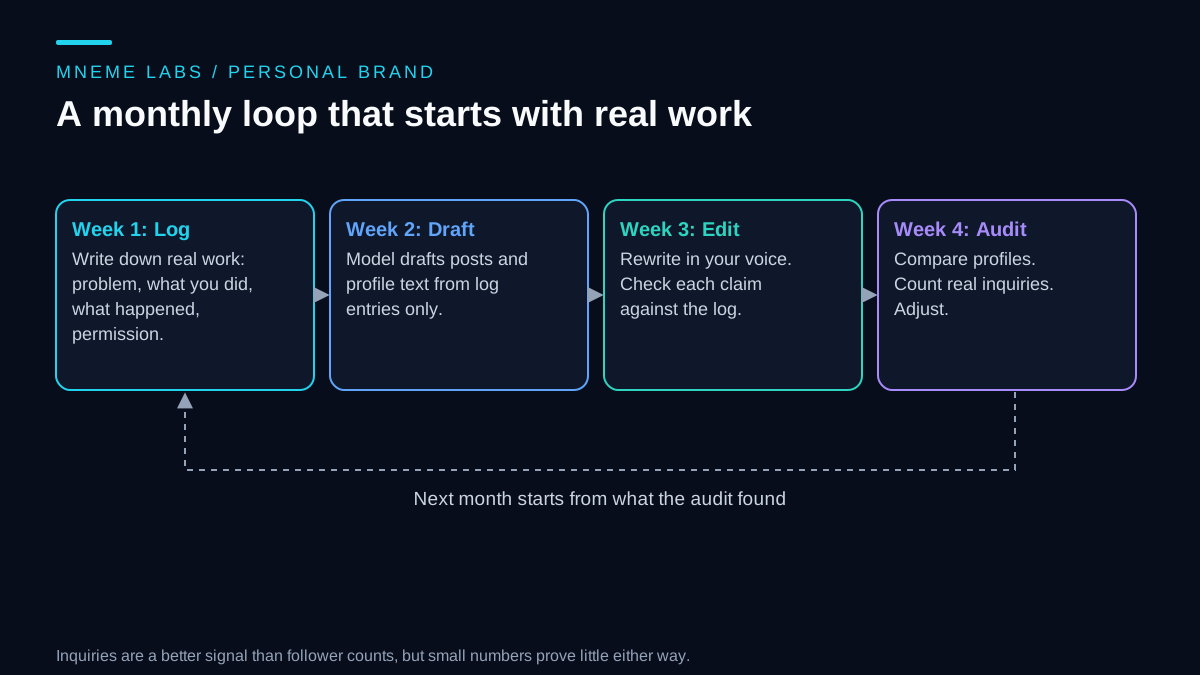
A brand needs steady, modest upkeep rather than bursts. A monthly loop works for many solo professionals.
Week 1: log. Write down the work from the past month while it is fresh.
Week 2: draft. Have a model draft one or two posts and any profile updates from the new entries.
Week 3: edit. Rewrite in your own voice. Read each claim against the log. Cut any sentence you cannot support.
Week 4: audit. Run the profile check, and count the inquiries that came through your profile or site that month, with a note on where each came from.
Measure with care. Followers, likes and impressions are easy to count and say little about whether anyone wants to work with you. Inquiries are closer, and a handful a month is too few to show what works. Treat any pattern in a small count as a question to test, not a result. If you add a tool that schedules posts or collects numbers, check what it does with your accounts and data first. The monitoring guide explains how to keep an automated step honest.
Failure cases to plan for
The invented credential. A draft adds a certification or a client name that is not in the log. Cut it. Check bios and "about" lines especially.
A voice that is not yours. Drafts drift toward a generic, polished tone. Compare against a few paragraphs you wrote yourself, and edit toward those.
A positioning that is too broad. "I help businesses grow" fits everyone and persuades no one. Narrow it until a reader can say yes or no.
Posting to fill a calendar. Content with nothing to say weakens the brand. Skip a week instead.
Leaking client information. A story that is vague to you can be recognizable to the client. When in doubt, ask permission or leave it out.
Undisclosed paid relationships. If a post is sponsored or earns you an affiliate commission, say so clearly. The affiliate guide covers disclosure.
Limits
A proof log and a consistent profile will not create demand on their own. They make you easier to trust once someone finds you. This guide does not cover how people find you, which depends on your field, your network and your audience. It also says nothing on how any ranking system treats your pages. Google's questions describe qualities of helpful content and do not promise placement. Specific markup is also not a shortcut. Google's ProfilePage structured data is documented for sites where creators share first-hand perspectives, such as communities, and a personal site does not need it to have a good About page.
Next step
Open a blank document and start the proof log with five real entries from the past year, including whether each can be shared. Write the positioning statement last, from what the log supports. Then list every place that describes you, and run the consistency check by hand before you automate anything. If the list surprises you, the drift was already there.
Sources
- Google Search Central, Creating helpful, reliable, people-first content: self-assessment questions on original information, first-hand expertise, author background, and extensive automation as a warning sign.
- Google Search Central, Profile page structured data: ProfilePage markup is meant for sites where creators share first-hand perspectives.
- 16 CFR 465.2, Fake or false consumer reviews, consumer testimonials, or celebrity testimonials: misrepresenting that a testimonial writer exists, used the business, or what their experience was is unfair or deceptive.