A pile of applications is a reading problem. A model is good at reading and summarizing, so it is tempting to let it sort the pile, drop the bottom half, and hand you a short list. The trouble is that the short list is a decision. If a model quietly decides who a hiring manager never sees, errors in that model become errors in who gets a job, and the people affected will not know it happened.
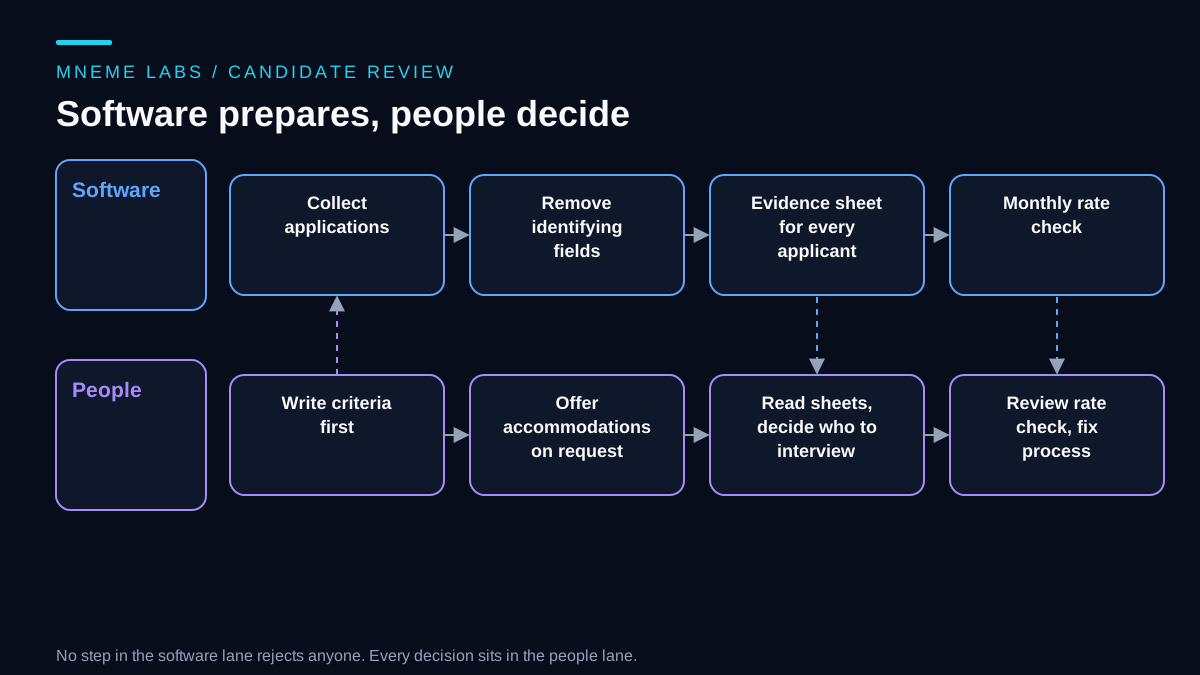
This guide describes a narrower use. The software prepares an evidence sheet for each applicant, showing what the application says about each job requirement. People read the sheets and decide. The guide does not promise speed, and it does not claim that any tool removes bias. It describes a workflow with human decisions at every step that affects a candidate. The role in the examples, an office coordinator at a small clinic, and every applicant record are synthetic. This is general information and not legal advice. Employment law differs by country, state and employer size, so ask a qualified adviser what applies to you.
Write the criteria before you read any application
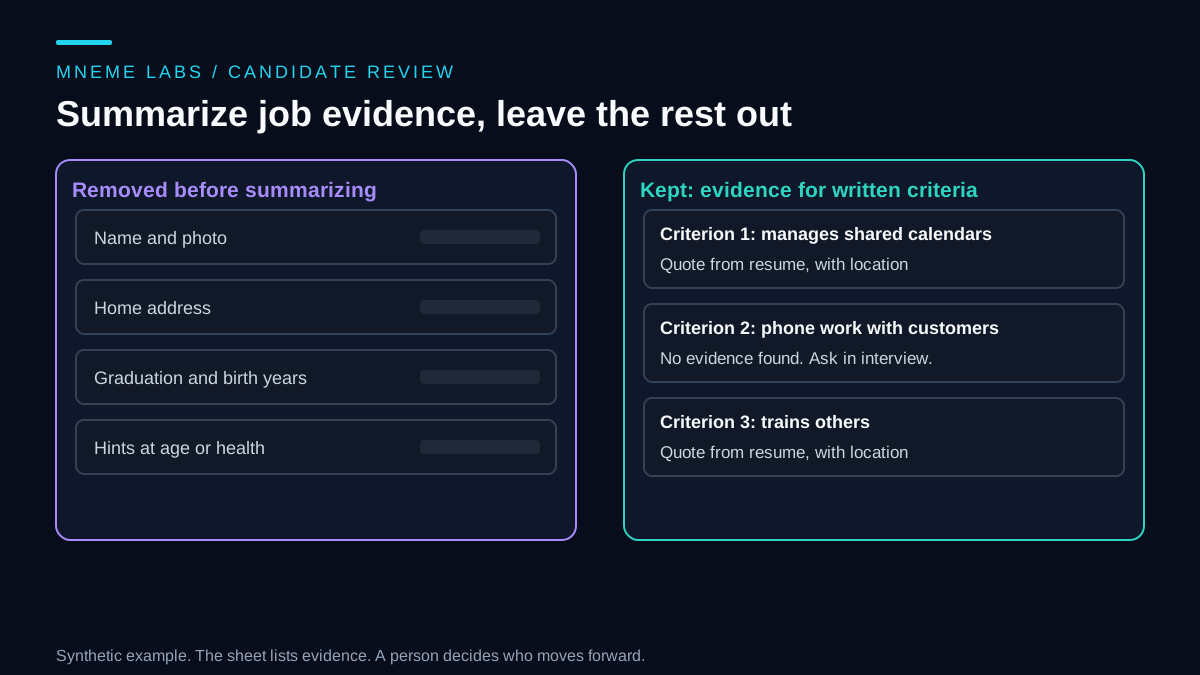
Start with the job, not the pile. List the duties, then turn them into a short set of criteria that a person could reasonably demonstrate. For the clinic's office coordinator, three examples are managing shared calendars, handling phone contact with customers, and training others on a system. Separate must-haves from nice-to-haves, and say what kind of evidence counts. Work experience, a course, a volunteer role, or a short task can all count as evidence.
Writing criteria first prevents a quiet drift. If you read applications first, the criteria bend toward whoever you happened to read. Written criteria also give you a standard to point to when you explain a decision later. Keep them tied to what the job needs. Requirements such as a particular school, a recent graduation year, or no gaps in employment often work as stand-ins for things the job does not need.
Remove fields that do not belong in a first review
Before any model sees an application, strip fields that are not job evidence: name, photo, home address, birth and graduation years, and anything that hints at age, health, family status or origin. This is a data minimisation step. The UK Information Commissioner's Office, after auditing providers of AI recruitment tools, said some tools did not process personal information fairly, for example by letting recruiters filter out candidates with certain protected characteristics. It also listed what a recruiter should ask before buying such a tool in its key data protection considerations for AI in recruitment. Among them are completing a data protection impact assessment, identifying a lawful basis, documenting who is responsible for what, checking that the provider has mitigated bias, and being transparent with candidates about how a tool uses their information.
Removing fields is not a guarantee. Details such as a club name, a school or a town can still point to a protected trait. Tell the model never to infer or mention protected characteristics, and check outputs for any such mention. Do not ask a model to guess someone's age, health, gender or background from their writing or photo, and do not run searches on candidates' social media as part of a screening step.
Build an evidence sheet, not a score
For each applicant, ask the model one narrow question per criterion: "Quote the sentence in the resume that shows this, or say you found nothing." The output is a sheet with a quote and a location for each criterion, or a blank. It is not a score, a rank, or a verdict. Ranking turns a reading aid into a decision, and numbers make weak signals look precise.
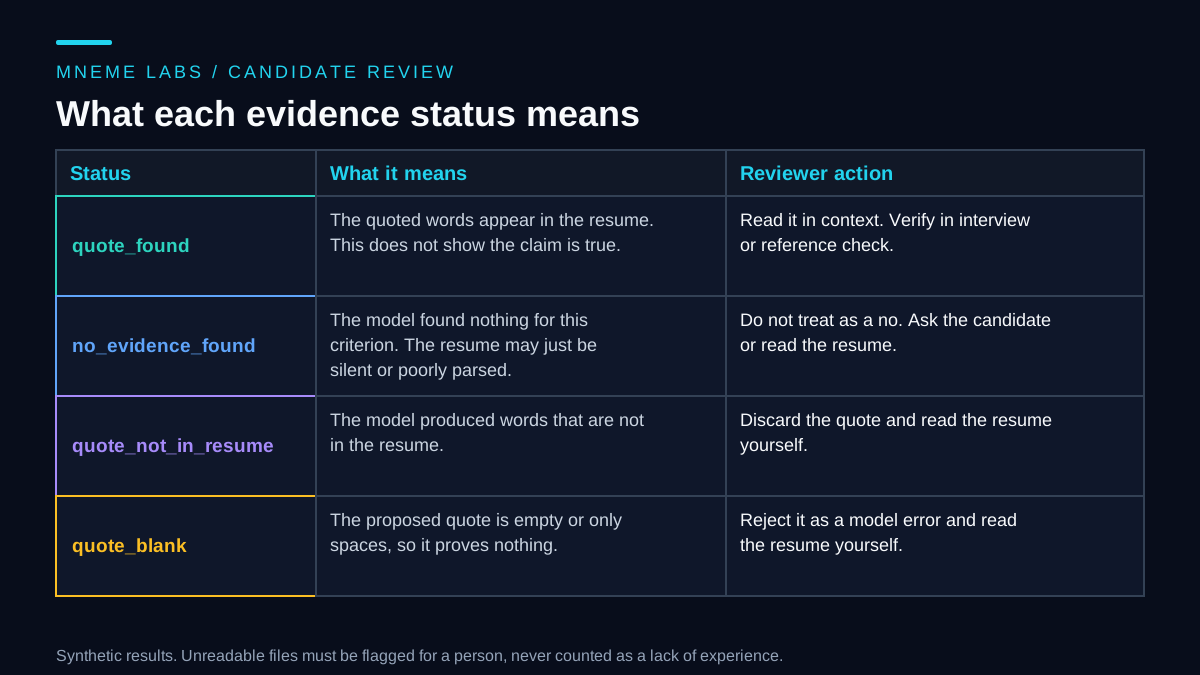
Then check the sheet with code. A model can produce a quote that sounds right and does not appear in the resume. A simple text match catches that. A matching quote is not the same as a true claim, though. A resume can say anything. Even a single common word can pass a substring check while providing no evidence for the criterion. Require a meaningful passage with its surrounding context during human review; the code reports text presence only. The person reading must still weigh the claim, ask about it in an interview, and check references.
The Python below does the quote check, a readability check, and a selection-rate comparison. It uses only the standard library and was run on made-up text and counts.
import re
from fractions import Fraction


def norm(s: str) -> str:
    return re.sub(r"\s+", " ", s).strip().lower()


def readable(text: str, min_chars: int = 200) -> bool:
    """A nearly empty parse (for example a scanned PDF) must not be read as 'no qualifications'."""
    return len(text.strip()) >= min_chars


def verify_evidence(evidence: dict, resume_text: str) -> dict:
    """evidence maps each job criterion to a quote the model proposed, or None."""
    src = norm(resume_text)
    out = {}
    for criterion, quote in evidence.items():
        if quote is None:
            out[criterion] = "no_evidence_found"
        elif not isinstance(quote, str):
            raise TypeError(f"quote for {criterion!r} must be a string or None")
        elif not norm(quote):
            # An empty string is contained in every text, so reject it first.
            out[criterion] = "quote_blank"
        elif norm(quote) in src:
            out[criterion] = "quote_found"
        else:
            out[criterion] = "quote_not_in_resume"
    return out


def _whole(x) -> bool:
    return isinstance(x, int) and not isinstance(x, bool)


def selection_rates(counts: dict, small_n: int = 30) -> dict:
    """counts: {group: (selected, applicants)}. Rough screening signal only.

    Raises ValueError unless both numbers are whole and 0 <= selected <= applicants.
    """
    for g, pair in counts.items():
        s, n = pair
        if not (_whole(s) and _whole(n) and 0 <= s <= n):
            raise ValueError(f"{g!r}: need whole numbers with 0 <= selected <= applicants, got {pair!r}")

    rates = {g: Fraction(s, n) for g, (s, n) in counts.items() if n > 0}
    top = max(rates.values(), default=Fraction(0))
    out = {}
    for g, (s, n) in counts.items():
        if n == 0:
            out[g] = {"status": "not_measurable", "note": "no applicants"}
            continue
        r = rates[g]
        row = {"status": "measured", "rate": round(float(r), 3),
               "ratio_to_highest": None, "below_four_fifths": None,
               "small_sample": n < small_n, "note": ""}
        if len(rates) < 2:
            row["note"] = "ratio unavailable: fewer than two groups can be measured"
        elif top == 0:
            row["note"] = "ratio unavailable: nobody was selected in any group"
        else:
            ratio = r / top
            row["ratio_to_highest"] = round(float(ratio), 3)
            row["below_four_fifths"] = ratio < Fraction(4, 5)
        out[g] = row
    return out
On the synthetic resume, a quote copied from the text comes back as quote_found even when spacing differs. A criterion with no quote comes back as no_evidence_found. A made-up quote about leading workshops comes back as quote_not_in_resume. An empty or whitespace-only quote comes back as quote_blank, because an empty string sits inside any text and would otherwise pass as found. A blank parse fails the readability check. Two statuses deserve care. no_evidence_found does not mean the candidate lacks the skill, since the resume may be silent or badly parsed. An unreadable file must go to a person and never count as a lack of experience.
People decide, and everyone gets read
One safeguard is simple. Software never rejects anyone. The evidence sheet goes to a person for every applicant, not only for those a model liked. If the volume is too high to read everything, narrow the front of the funnel with a human-set, job-based question on the application form, such as whether the person can work the required schedule, instead of asking a model to rank.
Human review reduces some risks, such as a rejection that nobody looked at. It does not guarantee a fair or lawful process, since a reviewer can carry the same biases or trust a tidy sheet too much. It is one control among several, alongside the criteria, the field removal and the outcome checks below.
This also matters legally in some places. In the UK, the ICO's draft guidance on automated decision-making says the UK GDPR provisions on automated decisions apply where a significant decision is made by solely automated processing with no meaningful human involvement. It also lists risks such as bias and over-generalisation. A rejection that no person reviewed is a clear example of what to avoid. The page was marked as updated in March 2026 and is under review, so check the current version.
Make room for accommodations
An application process has to work for people with disabilities. In the United States, the ADA regulation at 29 CFR 1630.9 says a covered employer must make reasonable accommodation to the known physical or mental limitations of an otherwise qualified applicant with a disability, unless it would cause undue hardship, and it must not deny a job to such an applicant because of the need for an accommodation. Coverage depends on employer size and location.
In practice, give every applicant a plain way to ask for a different format or more time. This matters most for timed online assessments, video interviews and chat-based screening, where a fixed format can disadvantage someone for reasons unrelated to the job. A person, not a chatbot, should handle the request, and a request should not count against the candidate.
Watch the outcomes, not only the process
A process that looks fair can still produce skewed results. The US federal Uniform Guidelines on Employee Selection Procedures, in 29 CFR 1607.4, say an employer using selection procedures should keep records of their impact by race, sex and ethnic group, with appropriate safeguards so those records are used for proper purposes. It describes the four-fifths rule: a group's selection rate below 80 percent of the highest group's rate will generally be regarded as evidence of adverse impact. It adds that smaller differences can still matter, and that larger differences based on small numbers may not be statistically significant.
Take synthetic counts. Group A has 12 selected out of 40 applicants, a rate of 0.30. Group B has 6 out of 35, a rate of about 0.17. The ratio is about 0.57, which falls below four-fifths and would call for a closer look. A third group with 1 of 8 applicants is flagged too, but with 8 people, the number says very little. That is the reason the sketch labels small samples.
The function also checks its input and says when a comparison is not possible. Each group needs whole numbers with selected between 0 and applicants, and anything else raises a ValueError. A group with no applicants is reported as not measurable and left out of the comparison. If nobody was selected in any group, every rate is 0 and the ratio to the highest rate is unavailable, so the function labels it that way and does not divide. A single measurable group has nothing to compare against, so its ratio is unavailable too.
A flag is a reason to ask questions, not a verdict. Look at which step produced the gap: the job post, the criteria, the evidence sheets or the interviews. Demographic data, where you collect it at all, should be voluntary, kept apart from the people deciding on candidates, and used only for monitoring. Whether and how you may collect it varies by place, so confirm this with an adviser first.
Failure cases to plan for
Invented evidence. The quote check catches words that are not in the resume. It cannot catch a claim that is in the resume and false.
Parsing failures. Scanned documents, tables and unusual layouts produce empty or scrambled text. Flag any unreadable file for a person.
Keyword bias. A model or a filter that rewards particular phrases favors people who write resumes in a certain style. Keep criteria about the work, and read sheets with that in mind.
Hidden proxies. Removing a name does not remove every signal. Review which fields you pass in.
Candidate experience. People who apply deserve to know that a tool is involved and what a human does. Say so in the job post and in acknowledgment emails.
Records. Keep the criteria, sheets and decisions for the period your local rules require, and delete them when you no longer need them.
Limits
This workflow does not tell you who will perform well. Evidence sheets summarize what applicants wrote about themselves, and that is only the start of an assessment. Interviews, work samples and references remain the better sources. The four-fifths comparison is a rough screening signal from US federal guidelines. It is not a legal test of a particular process, and it is not a UK test. The UK material above comes from the ICO, and UK guidance is under review and changing, so check the current UK guidance before relying on it. Laws on automated hiring tools are also changing, and some places require notices or audits, so check the rules where your candidates live.
Next step
Write three to five criteria for one open role, strip identifying fields from a few past applications, and build the evidence sheet by hand once. Compare it with what a model produces, and look for any quote that fails the check. For a primer on structuring a first agent, see the first agent guide, and for tracking whether it behaves, see monitoring an agent.
Sources
- UK: ICO, Thinking of using AI to assist recruitment? Our key data protection considerations: audit findings on fairness and data minimisation, and questions to ask before procuring a recruitment AI tool.
- UK: ICO, What is automated individual decision-making and profiling: definition of automated decision-making, and bias and over-generalisation risks (draft guidance, updated March 2026).
- US: eCFR, 29 CFR 1607.4, Information on impact: impact records, safeguards for their use, and the four-fifths rule with its small-number caveat.
- US: eCFR, 29 CFR 1630.9, Not making reasonable accommodation: reasonable accommodation for known limitations of qualified applicants, unless undue hardship.