A content service looks like a simple business: a client pays a monthly fee, you deliver posts, and a model does much of the typing. The difficulty is that a model removes the cheapest part of the work. Checking facts, matching a voice, handling revisions and talking to the client remain, and those hours decide whether a package earns money or loses it.
This guide is about the economics of ongoing delivery. It does not list services to sell or promise any income, and it uses an invented service with made-up prices and minutes. The goal is to show how to turn a package into a time budget, see what changes the margin, and put quality gates where they protect both the client and you. If you want the drafting workflow itself, see the guide on drafting blog posts with a source-first workflow. For the earlier step of winning a first client, see the first client guide.
Count minutes per deliverable, not the length of the draft
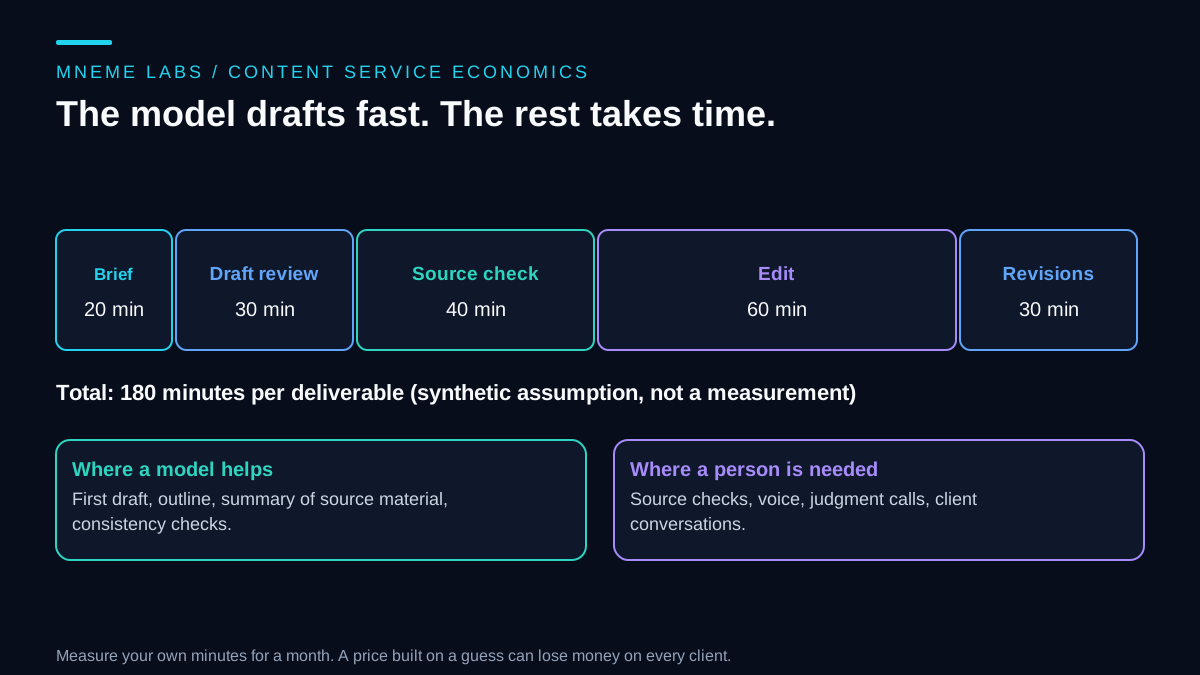
A deliverable is whatever the client receives and approves, such as a blog post, a newsletter or a set of social captions. Break its work into steps and give each a time. For an article in the invented service, the steps are:
- Brief. Confirm topic, audience, sources the client trusts, and what to avoid.
- Draft review. Read the model's draft and decide what is usable.
- Source check. Confirm each factual claim against a source you can open.
- Edit. Rewrite for the client's voice and clarity.
- Revisions. Make the changes the client asks for.
The figures in the diagram are assumptions: 20, 30, 40, 60 and 30 minutes, for 180 minutes per deliverable. Do not copy them. Time yourself on a few real deliverables, including the client back-and-forth, and use your own average. A first estimate that leaves out revisions or the source check will be too low, and you find out when the month is over.
Add the monthly work that does not belong to one deliverable. Planning topics, sending a report, answering questions and managing the calendar take time too. In the sketch below, that is 90 minutes a month.
Turn minutes into a margin
The Python below computes hours, profit and margin for one client in one month. Every input is an assumption you supply, including the value you place on your own time and the payment fee. It is standard-library code.
def client_month(price, n_items, per_item_min, monthly_overhead_min, hourly_value, tool_cost, fee_pct):
    """One client, one month. All inputs are assumptions you supply."""
    hours = (n_items * sum(per_item_min.values()) + monthly_overhead_min) / 60
    labor = hours * hourly_value
    fees = price * fee_pct
    profit = price - labor - tool_cost - fees
    return {"hours": round(hours, 2), "profit": round(profit, 2), "margin": round(profit / price, 3)}


def capacity(hours_available, hours_per_client):
    """Whole clients you can serve in the hours you have."""
    return int(hours_available // hours_per_client)
With invented inputs, an 800 monthly price for 4 articles, the minutes above, 90 overhead minutes, your time valued at 40 an hour, 25 in tools and a 3 percent fee, the sketch returned 13.5 hours, a profit of 211 and a margin of 26.4 percent. In that case, 100 available hours serve 7 clients. The test file confirms these values, and it also confirms the scenarios below, and all checks passed.
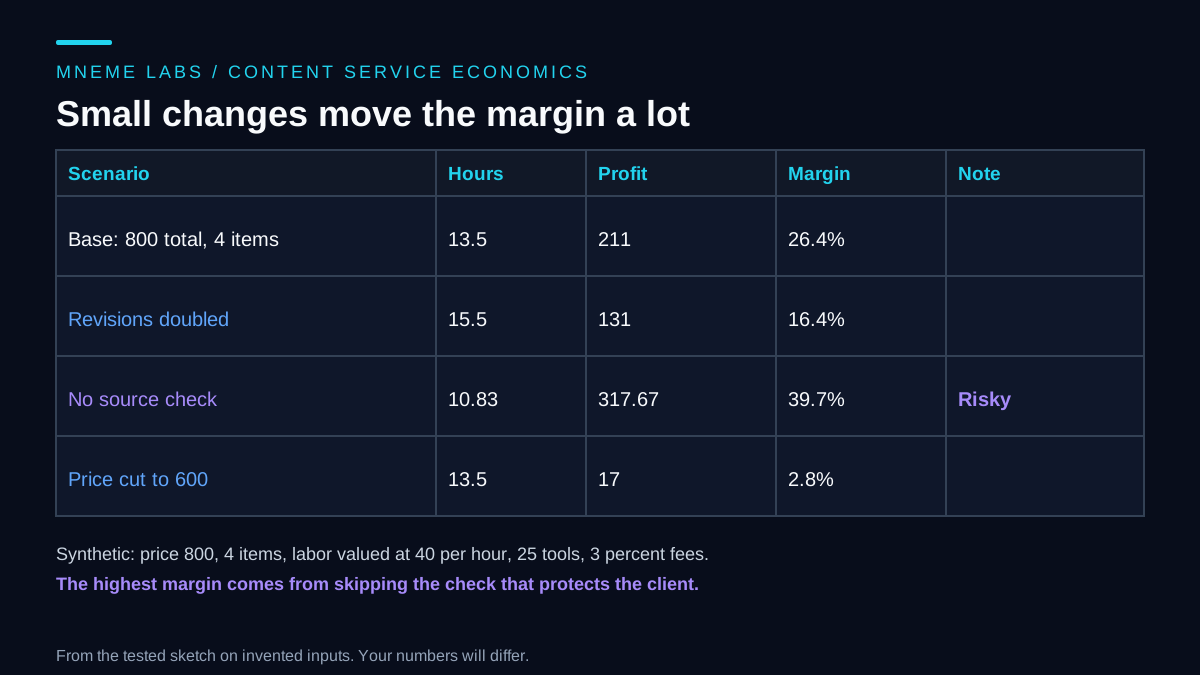
Change one input at a time and watch what happens.
- Doubling revision time (30 to 60 minutes per article) raised the monthly hours to 15.5 and cut profit to 131, a margin of 16.4 percent.
- A price cut to 600 with the same work left a profit of 17 and a margin of 2.8 percent.
- Skipping the source check gave the best margin, 39.7 percent, at 317.67 profit. That is also the change a careful service should refuse. The step that makes a post accurate is the first one a rushed provider cuts, and the client bears the cost when a wrong claim goes public under their name.
Two lessons follow. Revision limits and price matter more than how fast the model types. And a high margin that comes from removing a safety check is not a real margin.
Put limits in the package
Write the package so the time budget holds. A package description should say how many deliverables, how many rounds of revision are included, how long the client has to respond, what counts as a new request, and what happens when the client is late. A common failure is an open-ended "unlimited revisions" promise, which turns your fixed price into an hourly rate that falls with each round.
Choose a sign-off step too. The client approves the final text, or approves it by a stated deadline. That puts the decision to publish with them and gives you a record.
Build quality gates that you can afford
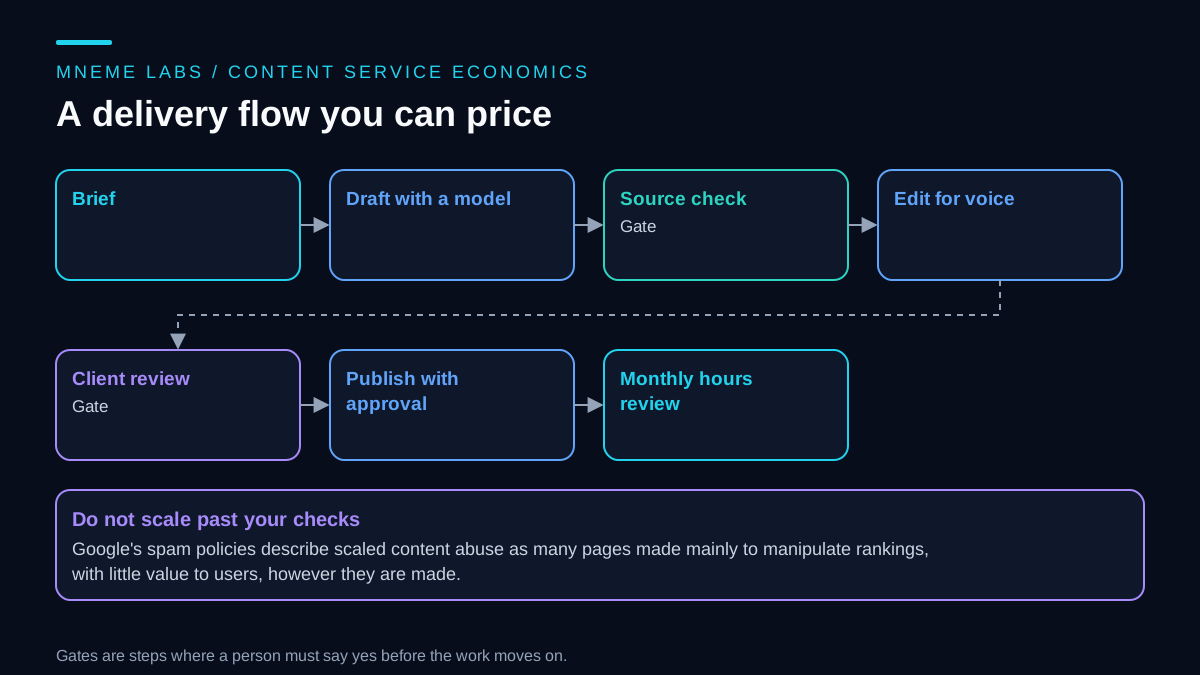
Two gates protect most deliverables. The first is the source check. For each factual claim, someone opens the source and confirms it says what the draft says. A model can list the claims and propose sources, but a person confirms. The second is the voice and judgment edit, where someone who knows the client reads the text as the client would.
Keep the gates cheap by narrowing what enters them. Use a brief with sources the client already trusts. Ask the model to cite which supplied source supports each claim and to mark any claim it cannot support. Remove such claims or find a source. Keep a short style note for each client with examples of text they approved.
Do not confuse volume with value
It is tempting to scale by producing many pages. Google's spam policies define scaled content abuse as generating many pages primarily to manipulate search rankings and not to help users, producing large amounts of unoriginal content that gives users little value, no matter how it is created. Its examples include using generative AI tools to generate many pages without adding value. A client who asks you for hundreds of near-identical pages is asking for a risk to their site, and a service that supplies them is part of the problem.
Google's guidance on people-first content points the other way. It asks whether content offers original information or analysis, shows first-hand expertise, has clear sourcing and author background, and is not produced by extensive automation across many topics. A smaller number of well-checked pieces that reflect the client's real experience is better aligned with those questions, and it also fits a package with a sensible time budget. None of that guarantees any search outcome. These pages describe what Google asks about content, not what any piece will earn.
Agree on rights and disclosure up front
Clients will ask who owns the work and whether AI was used. Answer in the agreement. State what you deliver, that you use AI tools in your process if you do, and who is responsible for checking claims before publication. On ownership, note that the legal status of AI-assisted material is still being worked out. The US Copyright Office's Copyright and Artificial Intelligence page says its report series includes a Part 2, published on January 29, 2025, that addresses the copyrightability of outputs created using generative AI. Read that report and ask a lawyer before you promise a client exclusive rights in AI-assisted text. Your human edits and original contributions may matter, and the rules differ by country.
Do not write fake testimonials or reviews for a client's site. The US rule at 16 CFR 465.2 makes it unfair or deceptive for a business to write, create or sell a consumer testimonial that misrepresents that the reviewer exists, used the business, or what their experience was. If you handle a client's review requests, collect real ones.
Failure cases to plan for
Underpriced packages. The margin is thin from the start, and one extra revision round removes it. Check the numbers before quoting.
Client delay. The client sits on approvals and expects posts on schedule. Put response times in the agreement and say what happens when they are missed.
One large client. If one client pays most of the bills, their loss ends the business. Track how your income splits.
Skipped checks under pressure. A busy week tempts you to ship unchecked text. Decide in advance that a late piece is better than an inaccurate one.
Sameness. Many clients in one niche get similar posts because the same prompts produce the same structures. Keep client-specific notes and examples.
Invisible rework. Time spent fixing a poor draft is still time. Record minutes per step for a month, and notice which step surprises you.
Reports that overclaim. Do not tell a client that a post "drove" results because traffic rose. Many things move traffic, and a correlation in a short window is weak evidence. Report what you can measure and say what you cannot.
Limits
The numbers in this guide are invented and show a method. Your minutes, rates, fees and clients will differ. The sketch ignores taxes, unpaid time between clients, sales effort, software that scales with usage, and the cost of mistakes. It also does not say how to find clients or how fast a service can grow. The legal points are general and drawn from US sources, so ask a lawyer about contracts and ownership where you work.
Next step
Time five real deliverables from brief to approval and write down the minutes. Put them into the sketch with your honest hourly value and see the margin. If it is thin, change the package before you change the model: cut the included revisions, raise the price, or narrow the deliverable. Then add the source check and client sign-off to your written process, and keep them even when you are busy.
Sources
- Google Search Central, Spam policies: definition and examples of scaled content abuse, including using generative AI to produce many pages without adding value.
- Google Search Central, Creating helpful, reliable, people-first content: self-assessment questions on original information, first-hand expertise, sourcing and extensive automation.
- US Copyright Office, Copyright and Artificial Intelligence: report series, including Part 2 on the copyrightability of generative AI outputs, published January 29, 2025.
- 16 CFR 465.2, Fake or false consumer reviews, consumer testimonials, or celebrity testimonials: writing or creating testimonials that misrepresent the reviewer or their experience is unfair or deceptive.