The hard part of a first client is not building the automation. It is agreeing on what you will build, for whom, how you will both know it worked, and what happens to the client's data in the meantime. Skipping that conversation can leave you with unpaid work that grows, or a pilot that cannot be judged because nobody wrote down what success meant.
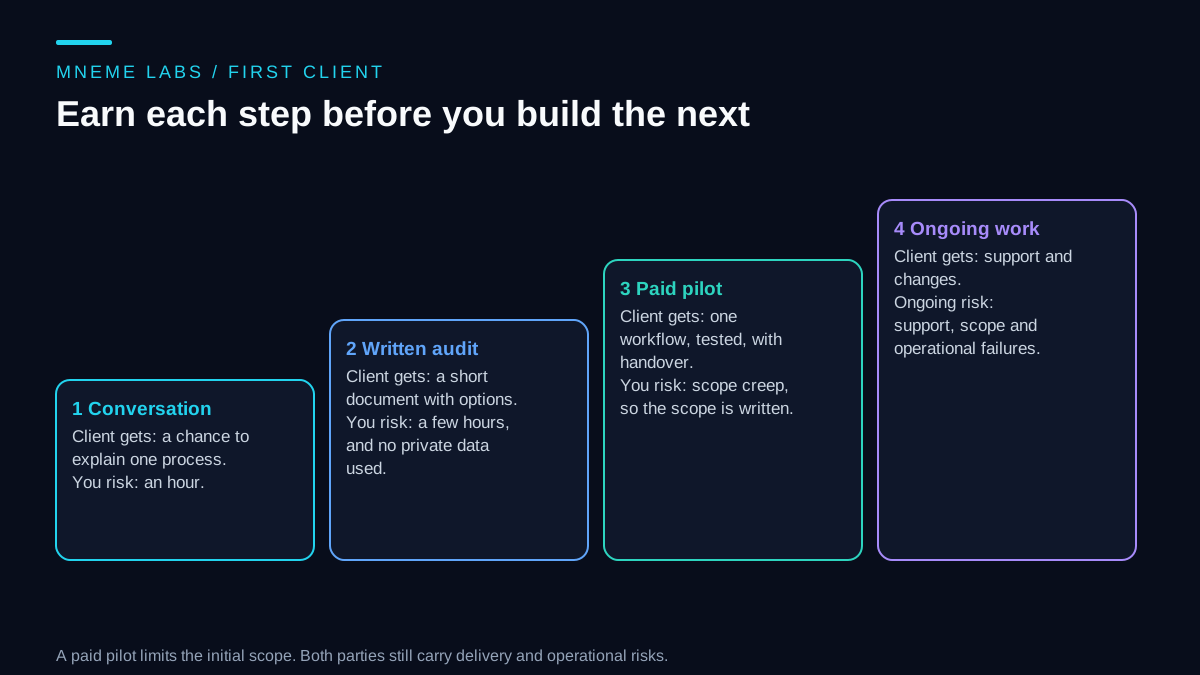
This guide describes a first-client path for someone selling AI-assisted automation to small businesses. It uses an invented small office and synthetic scope documents, and it states no income, client count or timeline that you should expect, since those depend on your market and skills. The path has four steps: a conversation, a short written audit, a paid pilot with a written scope, and ongoing work only after the pilot is reviewed.
Pick one narrow offer
A broad offer such as "AI for your business" gives a prospect nothing to say yes to. A narrow one names a type of business and a workflow. Examples: "sorting booking requests for small clinics" or "drafting replies to supplier emails for small shops". A narrow offer is easier to explain, easier to price, and easier to prove, because you can learn the same process once and reuse the lessons.
Choose it from what you already know. If you worked in a clinic office, you know the pain of three inboxes and a paper calendar. That knowledge is worth more than any tool list. If you have no domain background, pick a process that you can observe at a business you already deal with as a customer, and ask permission to learn from it.
Find the first conversation
For a first client, start with people who already know you: former colleagues, friends who own businesses, and local owners you have a relationship with. Ask to learn about a process, not to sell them something. A good opening is a question: "Which task takes your team the most time each week that is mostly copying and sorting?" Write down the answer in their words.
Cold outreach by email is a different thing and carries legal duties. In the United States, the CAN-SPAM statute at 15 U.S.C. 7704 says commercial email must not use misleading header information or deceptive subject lines, must identify itself as an advertisement unless the recipient consented, must give a clear way to opt out, and must include a valid physical postal address. Opt-out requests must be honored within ten business days. Other countries have different rules, and some are stricter, so check where your recipients are before you send anything in bulk.
Show proof without building the whole thing for free
Prospects do not believe claims. They believe something they can see. But a free full build is expensive for you and sets the wrong tone, since the client has not committed anything. A better proof is a short written audit.
An audit is a two-page document about one process, based on a conversation of thirty to sixty minutes. It describes the process as the client explained it, lists where time or errors seem to occur, proposes one small change, says what you would need access to, and names what is not included. You can make a short demo using synthetic data that you invent, which shows the shape of the idea without touching their records. Do not ask for real customer data at this stage, and do not use any that you are given on the spot.
The audit works as proof because it shows that you listen, write clearly and think about risk. It also gives the owner something to share with a partner or bookkeeper.
Write the scope before you write code
A paid pilot needs a written scope. It is not a legal contract, and a lawyer can help you turn it into one, but it is the document that prevents most misunderstandings. A short scope covers:
- Problem. One sentence in the client's words.
- Steps. What the workflow does, in order.
- Inputs and outputs. What goes in and what comes out. Outputs for a first pilot are usually drafts or reports.
- Success measure. One thing the client will count, such as missed requests per week before and after. Agree on it before you start.
- Decision owner. Who approves the outputs.
- Access. What accounts and data you need, and at what level.
- Price and duration. A fixed price and a short period.
- Handover. What the client receives at the end, such as a written runbook and a training session.
- Not included. What you will not do.
The Python below checks a scope for gaps. It does not judge whether the plan is wise. It only catches omissions and a few risky choices, which is where first pilots tend to go wrong. It is plain standard-library code, tested on synthetic scopes.
REQUIRED = ("problem", "steps", "inputs", "outputs", "success_measure", "owner_of_decisions",
            "price", "duration_days", "handover", "not_included")


def scope_gaps(scope: dict) -> list:
    gaps = []
    for key in REQUIRED:
        value = scope.get(key)
        if value is None or value == "" or value == []:
            gaps.append(f"missing: {key}")
    access = scope.get("access", "none")
    if access not in ("none", "read_only", "drafts_only"):
        gaps.append(f"access '{access}' is broader than a pilot needs")
    if scope.get("touches_personal_data") and not scope.get("data_terms_agreed"):
        gaps.append("personal data involved but data handling terms are not agreed")
    if scope.get("price") == 0:
        gaps.append("unpaid pilot: agree what the client commits instead (time, access, a decision)")
    if scope.get("duration_days", 0) > 45:
        gaps.append("pilot longer than 45 days: split it")
    return gaps
A complete synthetic scope returned no gaps. A weaker one, with no success measure, a price of zero, full administrator access, unagreed data terms and a 90-day length, returned all five matching gaps. A scope with no price field returned "missing: price", which is different from a zero price. Those are the cases in the test file, and all checks passed.
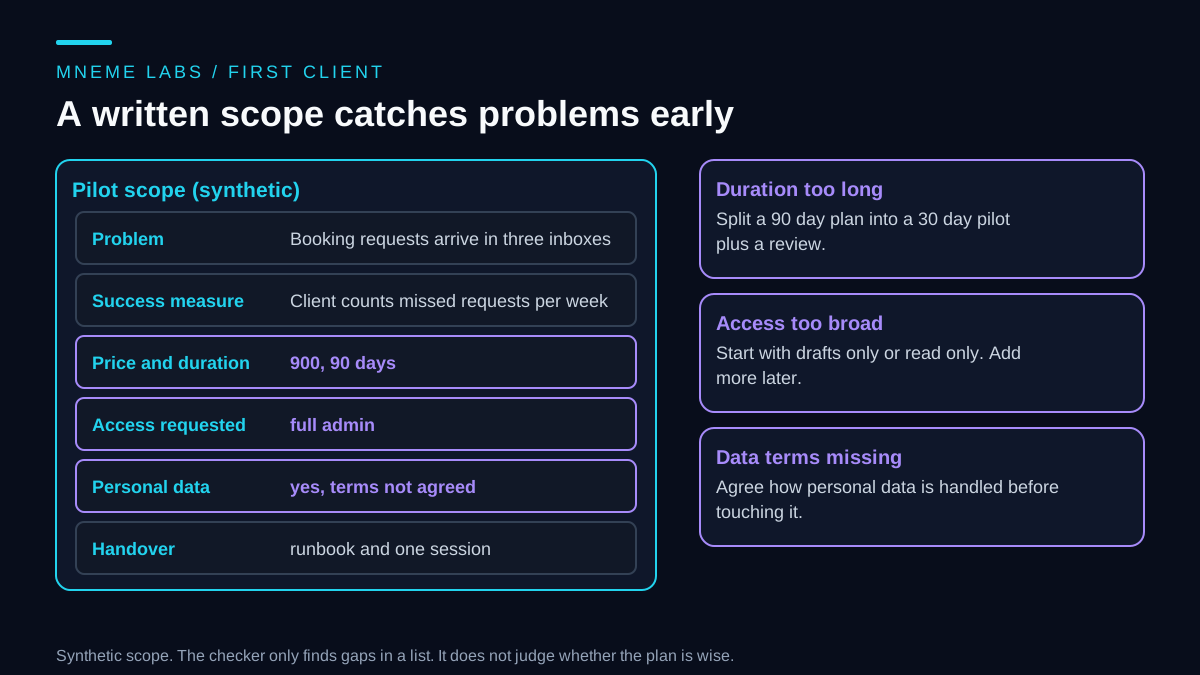
The 45-day limit and the access levels are choices for this sketch. Set your own, but keep the idea. A pilot should be short enough to end with a decision, and start with the smallest access that works, usually drafts only or read only.
Handle client data on purpose
If the workflow touches a client's customer or staff data, you are handling personal data on their behalf. In UK data protection law, that usually makes the client the controller and you a processor. The ICO's guidance on when a contract is needed says that every time a controller uses a processor, a written contract that binds the processor must be in place under Article 28(3), and that a processor who uses another processor needs a written contract with it as well. If you send client data to an AI provider, that provider may count as a sub-processor. Rules differ in other countries and some US states have their own, so ask a lawyer what applies, and agree the handling terms in writing before you touch any data.
In practice, this means three habits. Use the least data that works. Keep a list of every tool that sees client data. And make sure the client knows what you use.
Set up the business basics, briefly
Before you invoice, sort out the basics. In the United States, the Small Business Administration's page on business structures explains that a sole proprietorship does not separate your business and personal assets and liabilities, while an LLC generally protects personal assets in most instances, and that LLC members are treated as self-employed for tax purposes. The IRS's self-employed individuals tax center says self-employed people generally file an annual return, pay self-employment tax as well as income tax, and pay estimated taxes quarterly. These rules vary by country and by state, and an accountant is worth a short conversation before you take your first payment.
Run the pilot in a short, visible window
A 30-day pilot is a reasonable shape for a first workflow: a kickoff where the scope is signed, a week or so to set up access at the narrowest level, a first review of outputs together, a point where the agreed measure is counted, and a handover with a decision to stop, change or continue. Every step has a date and a person responsible.
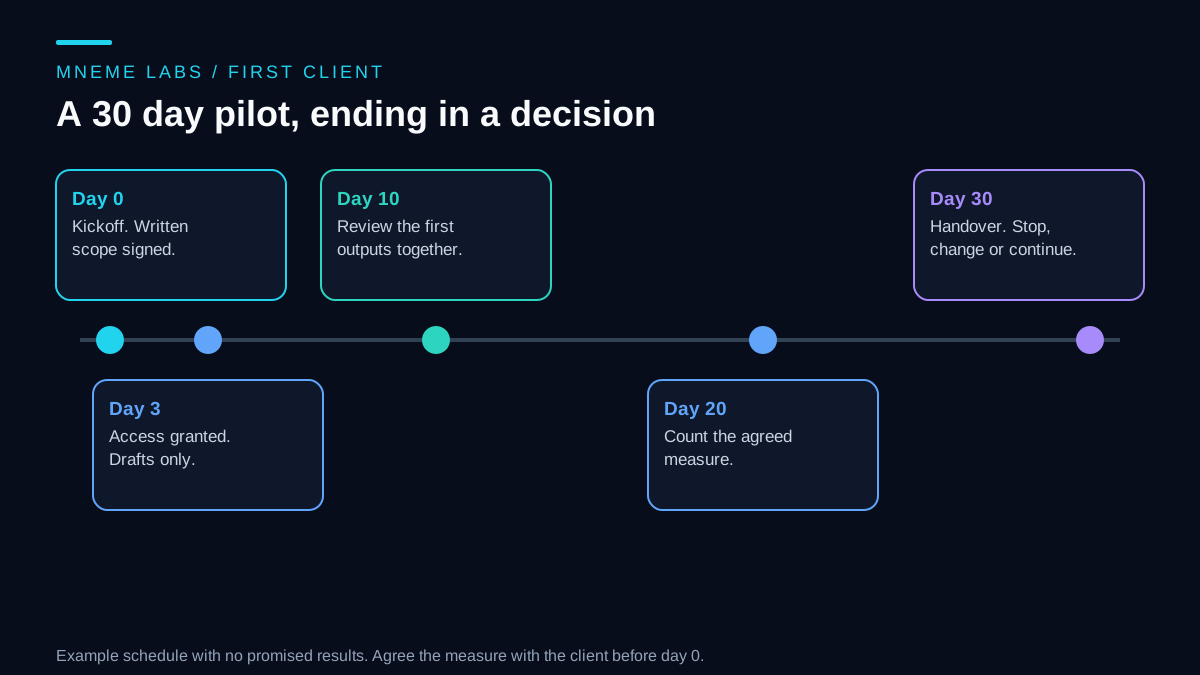
During the pilot, keep a person in the loop for anything that leaves the client's building. Drafts go to the decision owner, who sends them. Keep a short log of what the automation did and what the client changed in its drafts. At the end, count the agreed measure honestly, even if it is a modest or a poor result. A clear "this part worked, this part did not" report is more valuable to a next client than a polished claim, and it is a good basis for the next conversation.
Failure cases to plan for
Scope creep. The client asks for "one more thing" every week. Point to the not-included list, price the extra, or put it in the next phase.
Unpaid work that grows. If the pilot is free, the client has no reason to prioritize it. If you must discount, ask for something else in return, such as time from their team or a written testimonial that you may quote, and only with their agreement.
No measure. Without a number both sides agreed on, "did it work?" becomes an argument. Fix the measure before the start.
Access sprawl. You end up with passwords you should not hold. Use delegated or limited access, and remove it at the end.
Over-promising. Do not claim savings you have not measured. Describe what you will build and how you will check it.
No handover. If the client cannot run it without you, they have bought dependence, not a solution. Write the runbook.
The wrong client. A client who will not name an owner for decisions, will not agree a measure or will not pay for a small pilot is telling you something. It is fine to decline.
Limits
None of this guarantees a client. A first client depends on your network, your market and whether the problem you picked is one people pay to fix. The scope checker finds gaps in a list. It cannot tell you whether the pilot is a good idea. The legal, tax and data protection points are general, mostly from US and UK sources, and are not advice for your situation.
Next step
Choose one narrow workflow and write a one-page offer. Then book three conversations with people you know, and write one two-page audit from the best of them. Keep it to the audit until someone says they would pay for a pilot. For ideas on what an agent can safely do in an office, see the inquiry handling guide, and for monitoring a pilot, see the monitoring guide.
Sources
- 15 U.S.C. 7704 (CAN-SPAM), via Cornell LII: commercial email header and subject rules, advertisement identification, opt-out, postal address, and ten business days.
- ICO, When is a contract needed and why is it important?: written contract required between controller and processor (Article 28(3)) and for sub-processors (Article 28(4)).
- SBA, Choose a business structure: personal liability in a sole proprietorship and liability protection and self-employment tax for LLCs.
- IRS, Self-employed individuals tax center: annual return, self-employment tax and quarterly estimated taxes.