An AI model can write a smooth product description in seconds. It can also invent a port, a compatibility claim, or a customer who loves the product. The fix is not a better adjective list. The fix is to give the model a short list of checked facts and refuse any sentence that cannot point back to one.
This guide shows that method, called a claim ledger, using a made-up product so no real manufacturer is quoted. It covers what goes into the ledger, how to word compatibility facts, where the FTC's rules and Google's affiliate guidance apply, and a script that flags missing or disallowed claim references for human review. It does not promise traffic, commissions, or conversion gains, and it reports no test results.
What a claim ledger is
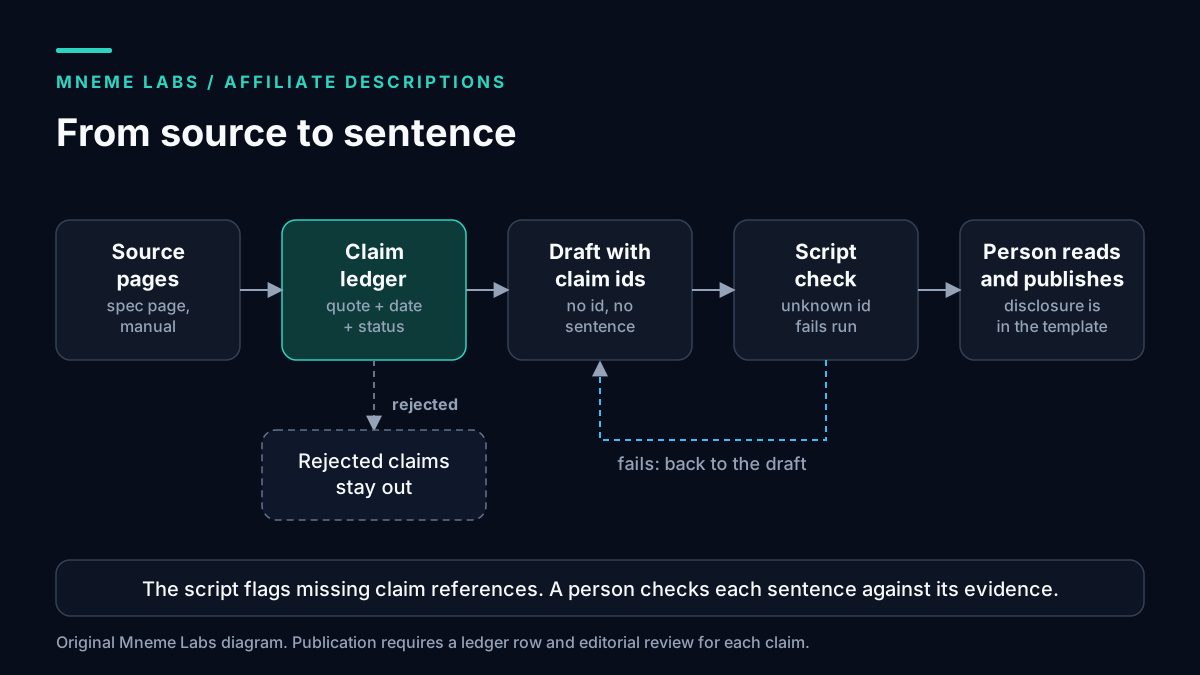
A claim ledger is a table you fill in before any writing happens. Each row holds one checkable statement about the product, where it came from, when you read it, and whether you may use it. The model is instructed to use verified facts and explicitly marked cautions, and a reviewer checks that it followed those instructions. You review the draft against the same rows.
Use these columns: an id (C1, C2), the claim in plain words, the source URL, a short quote copied from the source, the date you retrieved it, a type, and a status. Types worth separating are specification, compatibility, price, comparison, and experience. Statuses are verified, caution (usable only as a warning to the reader), and rejected.
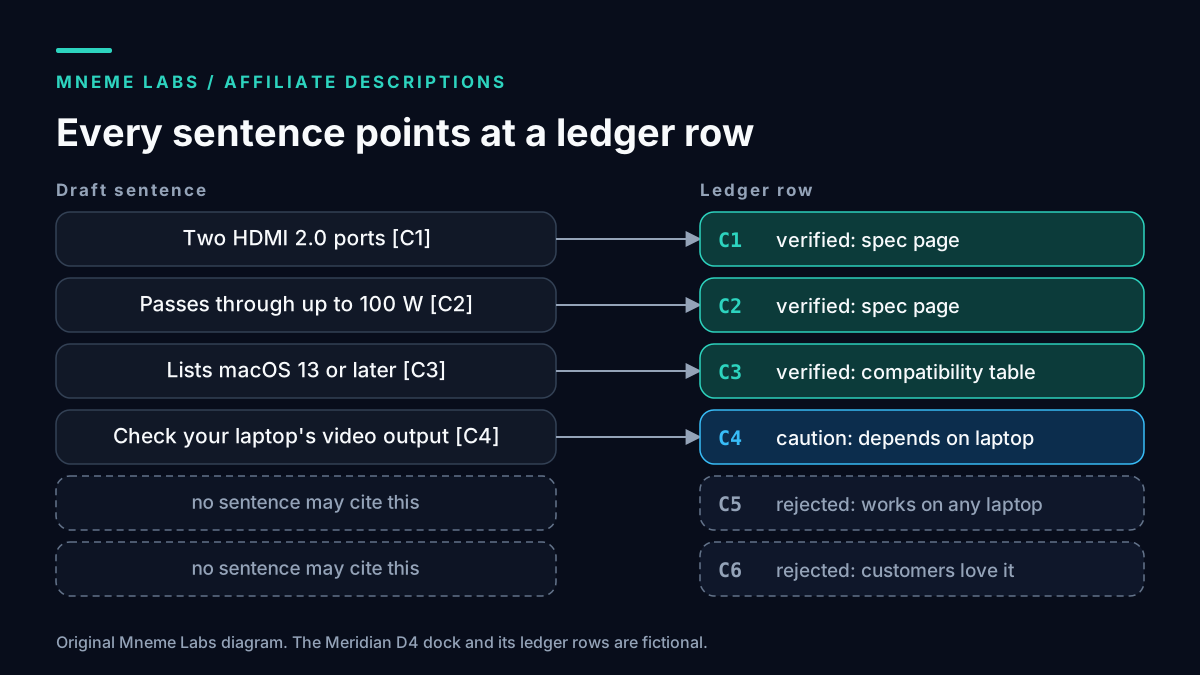
Here is a ledger for an invented product, the Meridian D4 USB-C dock. Every value is fictional and exists only to show the process.
| id | claim | type | status |
|---|---|---|---|
| C1 | Two HDMI 2.0 ports | specification | verified, manufacturer spec page |
| C2 | Passes through up to 100 W charging | specification | verified, manufacturer spec page |
| C3 | Lists macOS 13 or later and Windows 11 as supported | compatibility | verified, manufacturer compatibility table |
| C4 | Dual-display support depends on the laptop's video output | compatibility | caution, manufacturer spec page footnote |
| C5 | Runs two external displays on any laptop | compatibility | rejected, contradicts C4 |
| C6 | Customers love it | experience | rejected, no review data collected |
Rows C5 and C6 matter as much as the verified ones. A rejected row records a claim a model is likely to produce, and the reason you will not allow it.
Collect facts from sources you can name
Prefer the manufacturer's specification page, manual, or official compatibility list over a retailer listing, because retailer pages often repeat marketing copy. When two sources disagree, drop the claim or write what each source says and name it. Copy a short quote into the ledger so a reviewer can check the claim in ten seconds without reopening the page.
Keep price, discounts, and stock out of generated text entirely. They change quickly and the model cannot verify them. Send readers to the merchant page instead. If you discuss where to buy tools in general, point to this site's resources page or tools directory rather than adding a new affiliate destination to a description.
Write compatibility claims narrowly
Compatibility deserves a separate check because "works with" sounds simple and rarely is. A usable compatibility row names the exact model number, the other product or operating system, the version, and the condition. "Supports macOS" is weak. "The manufacturer lists macOS 13 or later" is accurate and carries its own limit.
If you have not tested a combination, say whose statement it is. "The manufacturer lists" is true when you read it in the manufacturer's table. "Works great with" is true only if you used it. Rows C4 and C5 show the other case: the source says dual displays depend on the laptop, so the description should tell readers to check their laptop's video specification and may not promise two screens.
Add a re-check date to every compatibility row. Firmware and operating system releases change what is supported, and a page that was accurate in March can mislead in November.
Draft from the ledger only
Give the model the verified and caution rows, the style rules you want, and one instruction: every sentence must end with the id of the row that supports it, and a sentence with no supporting row must not be written. A draft might look like this.
The dock has two HDMI 2.0 ports [C1] and passes through up to 100 W of charging [C2]. The manufacturer lists macOS 13 or later and Windows 11 as supported [C3]. Before counting on two external screens, check your laptop's video output specification [C4].
Notice what the model did not write: a verdict, an adjective like "sleek," or a claim about how it feels to use. If you have used the product, add that as an experience row with your own notes and a date. A model cannot create that row for you. Anthropic's guidance on reducing hallucinations recommends the same discipline: ask for supporting quotes, and remove any claim that has none.
Check the draft with a script
This standard-library Python script splits a draft into sentences and flags any sentence without a claim id, any id that is not in the ledger, and any id whose status is neither verified nor caution. A draft that cites C5 or C6 fails. Adjust the allowed statuses to match your own policy.
import re

def check(draft, ledger, allowed=("verified", "caution")):
    problems = []
    sentences = re.split(r"(?<=[.!?])\s+", draft.strip())
    for n, sentence in enumerate(sentences, 1):
        ids = re.findall(r"\[(C\d+)\]", sentence)
        if not ids:
            problems.append(f"sentence {n}: no claim id")
        for cid in ids:
            row = ledger.get(cid)
            if row is None:
                problems.append(f"sentence {n}: {cid} not in ledger")
            elif row["status"] not in allowed:
                problems.append(f"sentence {n}: {cid} is {row['status']}")
    return problems
The script checks whether each roughly split sentence contains a permitted claim id. Abbreviations, complex punctuation and malformed text can defeat this simple sentence splitter. It does not prove the row is correct, that the sentence matches the row, or that the wording is fair. A person still reads each sentence beside its quote.
Disclosure and the line on fake reviews
Two parts of the FTC's rules apply directly. The Endorsement Guides, codified at 16 CFR Part 255, include an example of a blogger who reviews coffee makers and earns a share of sales through affiliate links. The Guides say the reviews should clearly and conspicuously disclose that compensation. They define a clear and conspicuous disclosure as one that is difficult to miss and easy to understand, and on websites, one that is unavoidable. In practice, put the disclosure near the first affiliate link on the page, in plain words, not only in a footer or a separate page. This site's affiliate disclosure explains how its own links are labeled.
The second part is the FTC's rule on consumer reviews and testimonials, 16 CFR Part 465. It makes it unlawful for a business to write or create a review or testimonial that materially misrepresents that the reviewer exists, that the reviewer used the product, or what the reviewer's experience was. An AI-written "customer says" quote fits that description unless it reproduces a real customer's actual words. Do not generate testimonials, star ratings, or phrases like "buyers report." Row C6 exists to block them.
None of this is legal advice. The FTC publishes its own business guidance, and a lawyer who handles advertising law can tell you what applies to your situation.
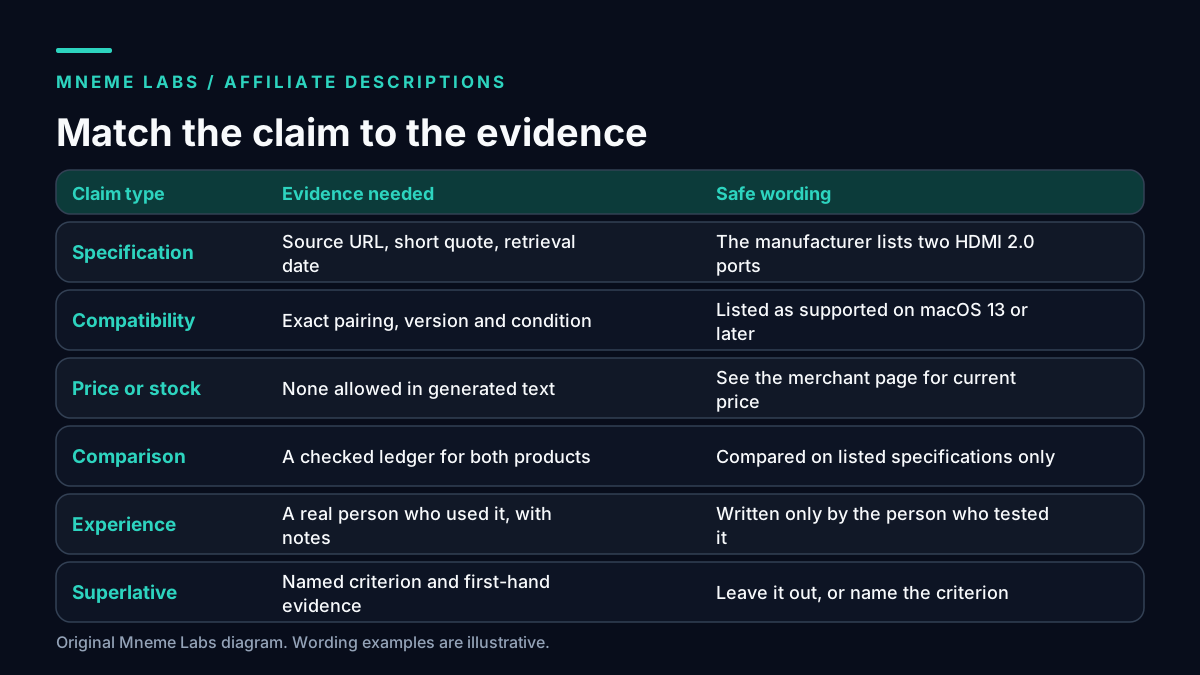
Match the claim to the evidence
The matrix above summarizes what each claim type requires. A specification needs a cited source and a date. A compatibility claim needs the exact pairing and its condition. A comparison needs a ledger for both products. A claim about experience needs a real person who used the product, with notes. A price needs nothing, because it stays out. A superlative like "best" needs an explanation of what it was judged against, and on a first draft it is usually safer to leave it out.
Add value or expect a thin page
Google's spam policies describe "thin affiliation" as publishing affiliate links with product descriptions and reviews copied from the merchant without original content or added value. They add that not every affiliate site is thin, and name examples of added value: price information, original product reviews, rigorous testing, and product comparisons. Google's guide to high-quality reviews asks for evidence of your own experience and an explanation of what separates a product from its competitors.
A ledger-based description is accurate, but it is not original on its own. If it is only a rewording of the specification page, it adds little. Use the ledger to make the factual layer reliable, then add what a person contributes: who the product suits, what to check first, which alternatives fit better, and anything you tested yourself. If you did not test it, say so.
Google's spam policy also covers scaled content abuse, which includes using generative tools to produce many pages without adding value for users. A hundred ledger-checked pages with nothing new on them can still land in that category.
Failure modes
- Wrong variant. The page lists the Meridian D4 but the retailer sells the D4 Lite. Put the exact model number in every ledger row.
- Flattering adjectives. Models add words like "powerful" and "seamless." Search drafts for adjectives not present in a source.
- Stale rows. A discontinued product or a changed specification stays on the page. Store the retrieval date and set a re-check interval you can sustain.
- Missing disclosure. The generator writes the body but nobody adds the notice. Make the disclosure part of the page template, not the draft.
- Invented social proof. Phrases like "customers say" or "rated highly" need real data. Otherwise cut them.
Limits
The script and ledger were written for this article and checked only against the invented example. No real product was tested. The FTC and Google sources describe general rules, and neither guarantees that a page will rank or that a disclosure meets every situation.
Next step
Pick one product you already know well. Build a ledger of five to ten rows, including at least one rejected claim. Generate a draft, run the script, then read every sentence beside its quote. Count how many rows you had to reject or correct. That number tells you how much review time each page will need before you try more than one.
For a related look at site-wide operations, see how AI agents fit into affiliate operations.
Sources
- 16 CFR Part 255, Guides Concerning Use of Endorsements and Testimonials in Advertising (eCFR). Used for the definition of clear and conspicuous (section 255.0) and the affiliate-link blogger example (section 255.5).
- 16 CFR 465.2, Fake or false consumer reviews (eCFR). Used for the prohibition on creating reviews that misrepresent the reviewer or their experience.
- Google Search Central: Spam policies. Used for thin affiliation and scaled content abuse.
- Google Search Central: Write high quality reviews. Used for first-hand evidence and comparison guidance.
- Anthropic: Reduce hallucinations. Used for the quote-and-retract technique.
Diagrams are original Mneme Labs illustrations. The product and ledger rows are fictional.