Affiliate income is not passive in the way the phrase suggests. Each page needs an offer that suits the reader, an honest account of why you recommend it, a disclosure the reader can see, and some upkeep after publication. A model can speed up pieces of this work. It cannot supply the part that makes a recommendation worth following, which is that someone actually knows the product.
This guide covers the decisions that come before and after the writing: whether an offer fits your audience, how to disclose the relationship, how to tag links so results are readable, and how to avoid reading too much into small numbers. The running example is a made-up newsletter for home espresso beginners. The reader data and numbers are synthetic, so nothing here describes real earnings, and no outcome is promised. For the maintenance side, such as link checks and stale facts, see how agents fit into affiliate operations. For product copy, see affiliate product descriptions with AI.
Start with the reader's problem, not the commission
An offer is a good fit when it solves a problem your readers already have and you can speak about it from experience. A high payout on something your readers do not need produces clicks at best and distrust at worst.
For the example newsletter, imagine the writer collects reader questions by reply. A recurring one is "why do my shots taste sour?" A grinder that gives a more consistent grind is a plausible answer. That comes from the reader's problem. It does not come from a list of programs with the highest rates.
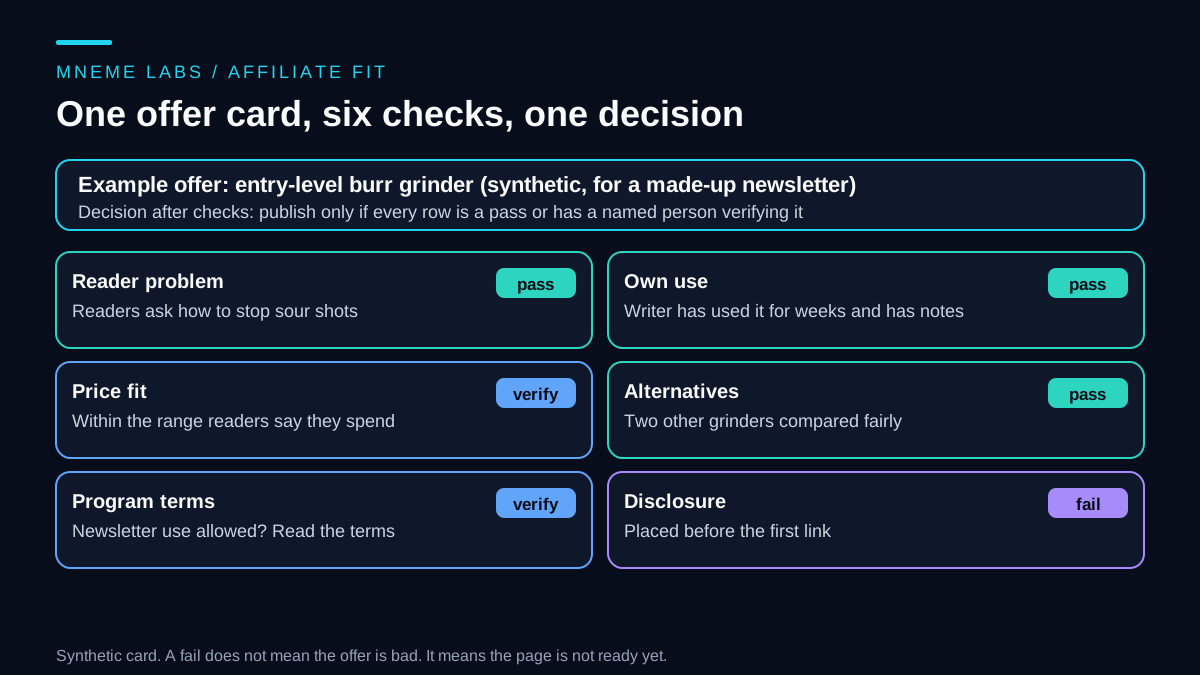
Score each candidate offer on six questions before you write a word:
- Reader problem. Can you point to questions, comments or survey answers that show the need?
- Own use. Have you used the product long enough to describe what happened, including what annoyed you? If not, either use it first or write a different kind of page, such as a summary of official specifications that says plainly that you have not tested it.
- Price fit. Does the price match what your readers say they spend?
- Alternatives. Have you covered at least one or two other options fairly, including one that is not an affiliate product?
- Program terms. Do the merchant's terms allow the way you plan to promote, such as email, social posts or paid ads? Terms differ, so read them for each program.
- Disclosure. Is the disclosure placed where a reader sees it before the first link?
The card above shows the idea. A "fail" on disclosure does not mean the offer is poor. It means the page is not ready.
What a model can do in this workflow
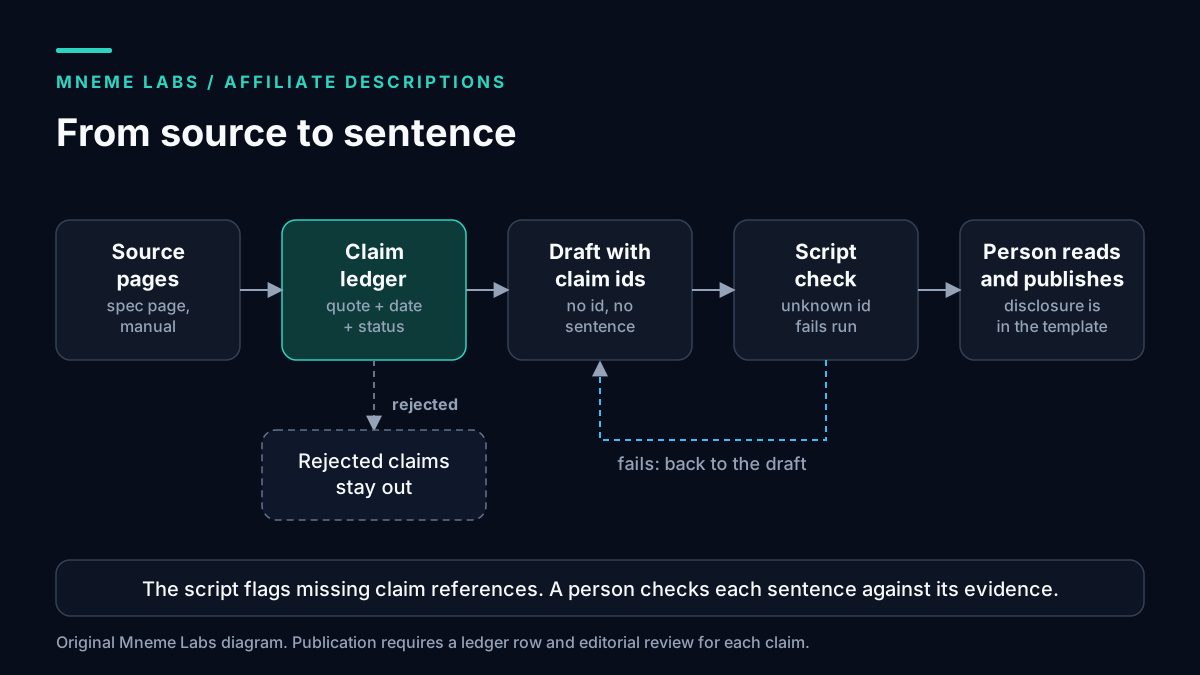
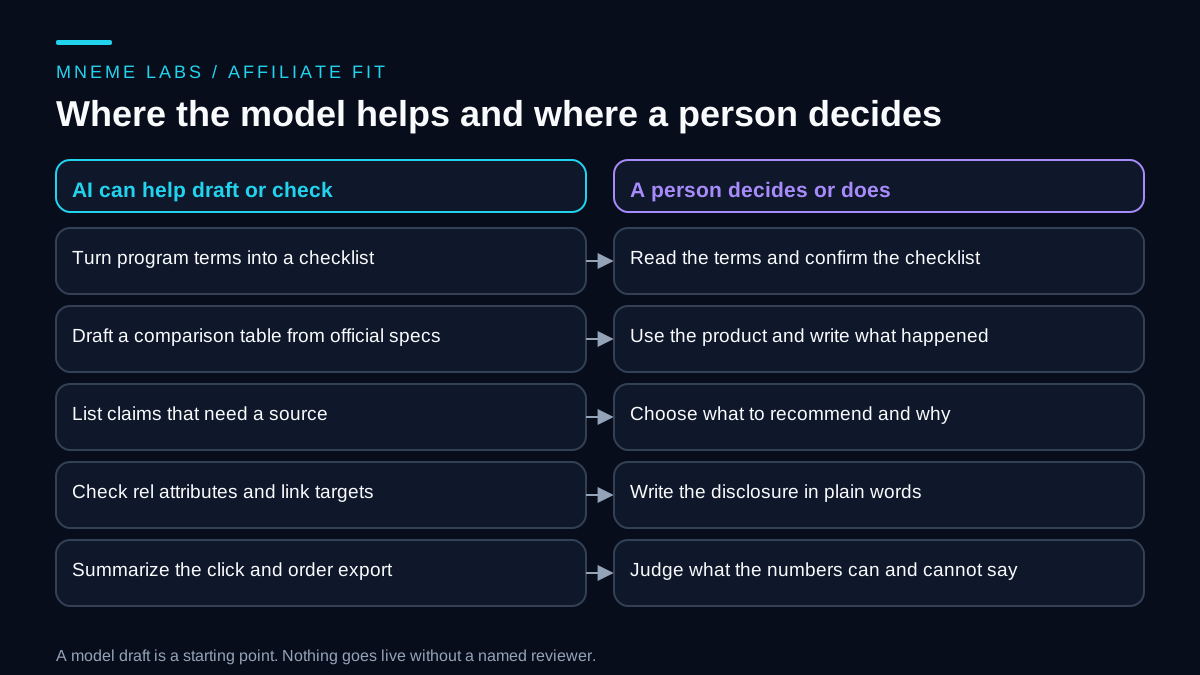
A model is useful on the reading and checking parts. You can paste a program's terms and ask for a checklist of what is allowed and prohibited, then read the terms yourself to confirm the checklist, because a summary can drop a clause that matters. You can ask for a comparison table drafted from the manufacturer's published specifications, then check each cell against the source. You can ask for a list of claims in your draft that need a source or a personal note.
A model should not invent the experience. It cannot say you used the grinder for a month. If a draft contains a sentence like that, the sentence is made up unless you wrote it from your own notes. The same goes for reviews, ratings and quotes from "customers". Google's guidance on writing high quality reviews asks for evidence of your own experience, a discussion of benefits and drawbacks based on your own research, an explanation of what sets a product apart from competitors, and a reason behind any "best for" label. It also suggests considering links to multiple sellers. Those are the parts a draft needs from you.
Write the disclosure first
Many readers do not know that a link may pay the person who wrote the page. The US Federal Trade Commission's Endorsement Guides, including 16 CFR 255.5, call for clear and conspicuous disclosure of a connection between an endorser and a seller that might materially affect how much weight the endorsement gets and that the audience would not reasonably expect. The Guides name monetary payment and the chance of being paid among the connections that can count. They also say a disclosure does not need every detail of the arrangement, but it must communicate the nature of the connection well enough for readers to judge its significance.
The Guides are guidance. They are not a standalone binding rule that creates its own penalties. They explain how the FTC reads the law against deceptive advertising, so an undisclosed material connection is a practical risk even though the Guides themselves are not a statute. Treat them as the standard to follow, and ask a lawyer how they apply to your case.
So write the disclosure before the draft, and place it where it cannot be missed, which means before the first affiliate link and in the same medium as the recommendation. A short plain version might read:
Some links on this page are affiliate links. If you buy through them, we may earn a commission.
Edit that to be true for your practice. Only add the phrase "at no extra cost to you" if that is accurate for the program. Do not rely on a footer, a hover label, or a separate page alone. This site has its own affiliate disclosure page. A short note near the links plus a fuller page is one workable pattern. The Endorsement Guides are US guidance. Other places have their own rules, and none of this is legal advice, so ask a lawyer if your situation is complicated.
Mark the links for search engines too
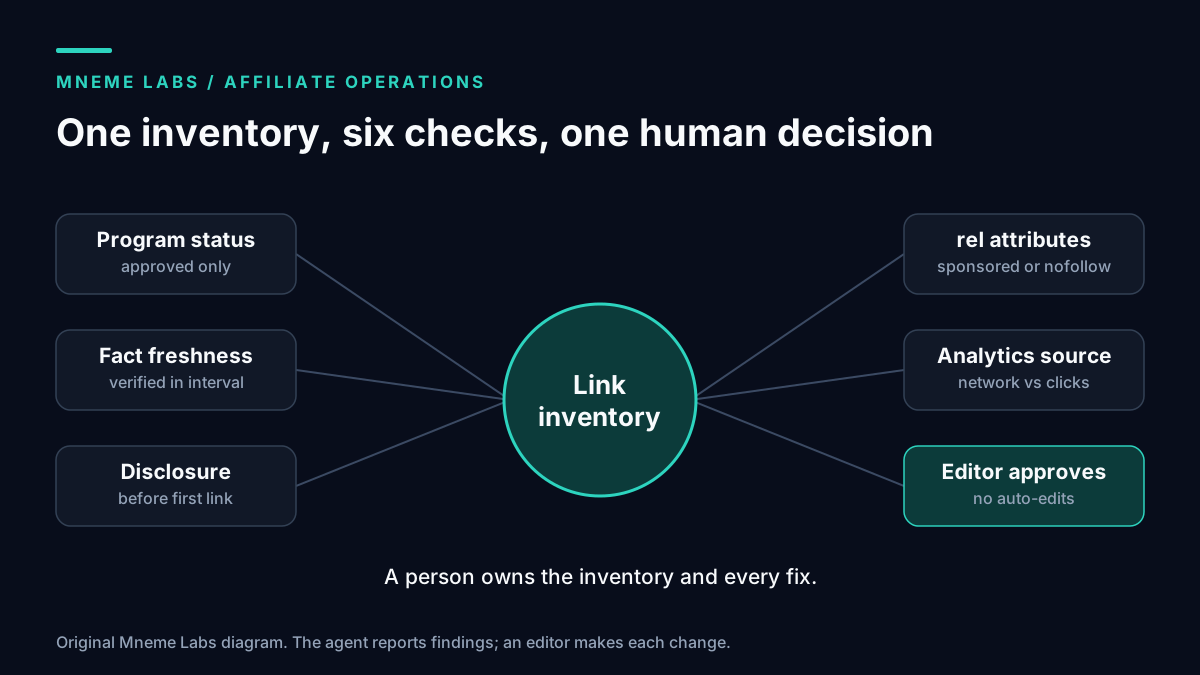
Disclosure to readers and link markup for search engines are separate jobs. Google's documentation on qualifying outbound links says to mark advertisements and paid placements with rel="sponsored", and that nofollow is still an acceptable alternative, though sponsored is preferred. Affiliate links fit that description. Because markup gets lost when a template changes, a short script or an agent that scans your pages for affiliate hosts without a rel value is a good use of automation. Treat a flagged link as a task for a person to check, not as a fix to apply blindly.
Tag every link so results can be read later
If every link to a merchant looks the same in your analytics, you can only see that "the grinder page did something". Give each placement its own tag, such as grinder-top for the link near the top of the page and grinder-bottom for the one near the end. Many programs accept a sub-ID or similar parameter for this. Check the program's documentation for the exact name and any limits, and do not put personal data in it.
Then collect two things. First, your own click counts per tag, from a redirect you control or from analytics. Second, the order report from the program, which lists approved orders and carries your tag when the program supports it.
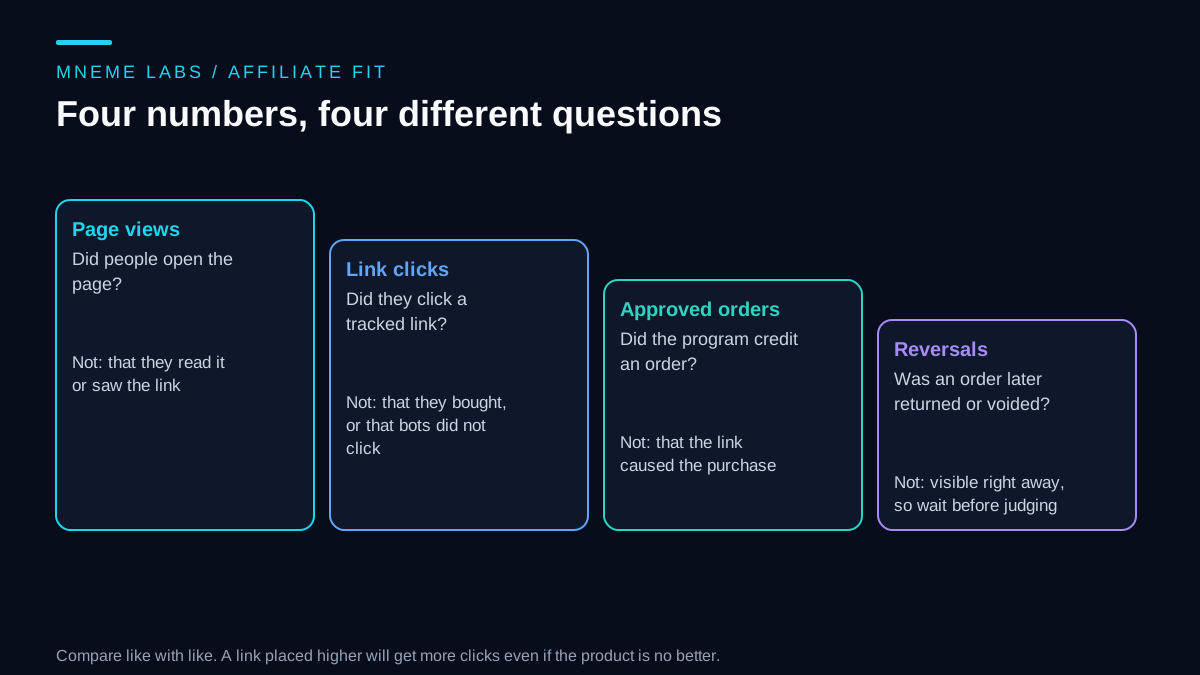
Impressions, visits, clicks and orders measure different things. A visit is not a click, a click is not an order, and an approved order is not proof the link caused the sale. Orders can also be reversed later through returns or voided sales, so early numbers can fall.
A small report that describes what it counted
The Python below counts tracked clicks and approved orders per tag and prints orders per 100 clicks next to the raw counts. It does not attach a confidence interval, a significance test or a winner, and the reason matters. Orders per 100 clicks is a descriptive ratio. It is not the probability that a person who clicked goes on to buy.
The two counts come from different systems, and they do not line up neatly:
- Clicks come from your redirect or analytics. Orders come from the program's report. Either side can miss events the other recorded.
- An order can be credited to a tag with no tracked click, for example when a browser blocked your counter.
- One click can lead to more than one order, so orders can exceed clicks and the ratio can pass 100.
- An order can arrive days after the click, so the two counts may cover different time windows.
Standard interval methods assume that each click is a single yes or no outcome from independent trials. These counts do not fit that assumption, so the sketch leaves such methods out and does not invent a substitute. The synthetic data below is written to show the behavior and does not suggest what a real newsletter earns.
from collections import Counter

UNTAGGED = "(untagged)"


def per_tag_report(clicks, approved_orders, few_clicks=100):
    """Descriptive counts per link tag. No interval, no significance, no winner.

    clicks: one tag per tracked click, from your redirect or analytics.
    approved_orders: one tag per approved order, from the program's own report.
    Every tag seen in either list gets a row, so orders with no tracked click
    stay visible. A missing or blank tag is grouped as "(untagged)".
    """
    def count(tags):
        return Counter(t.strip() if isinstance(t, str) and t.strip() else UNTAGGED
                       for t in tags)

    c, o = count(clicks), count(approved_orders)
    rows = []
    for tag in sorted(set(c) | set(o)):
        n, k = c[tag], o[tag]
        notes = []
        if n == 0:
            per_100 = None
            notes.append("orders but no tracked clicks: check tracking")
        else:
            per_100 = round(100 * k / n, 1)
            if k > n:
                notes.append("more orders than clicks: check tracking, time window, "
                             "and multiple orders per click")
            if n < few_clicks:
                notes.append("few clicks: one order moves this figure a lot")
        rows.append({"tag": tag, "clicks": n, "orders": k,
                     "orders_per_100_clicks": per_100, "notes": notes})
    return rows
Run on synthetic data with 40 clicks and 3 orders for grinder-top, 25 clicks and 1 order for grinder-bottom, and 400 clicks and 12 orders for kettle-top, it printed 7.5, 4.0 and 3.0 orders per 100 clicks. The first two rows carry the few-clicks note, since one more or fewer order would move them a lot. The report does not say which placement is better, and neither should you from these counts.
The awkward cases are handled in the same way, and each was run in a test. A tag with 2 orders and no tracked clicks shows its counts with no rate and a note to check tracking. A tag with 1 click and 2 orders prints 200.0 with a warning about tracking, time window and multiple orders per click. A tag with clicks and no orders prints 0.0. A tag that appears in only one of the two lists still gets a row.
Two further cautions apply. Tags measure placement and page, but readers who see a link at the top and a link at the bottom are not randomly assigned, so a difference could come from who scrolls where. And a product that does well on one page may do so because of what that page promises, not because of the product. When the data is thin, the useful move is to keep the page honest and wait, not to rewrite it every week.
Failure cases to plan for
The invented experience. A draft says "after three weeks of daily use" and nobody used the product. Remove the line or earn it.
The thin comparison page. A page that only restates manufacturer specs and adds links gives readers little. Google's review guidance, which also points to its policy on thin affiliate pages, asks for original value, so add your own testing, trade-offs and reasoning.
The silent change. A merchant changes terms, ends a program or retires a product. Put a review date on each page and check links on a schedule.
Disclosure drift. A redesign removes the note. Include disclosure in your link audit.
Chasing the rate. Moving a link because a few clicks looked better is reading noise. Wait for enough data or make the decision on reader value instead.
Limits
This workflow produces no income figure and offers no ranking promise. A good fit still earns little if the audience is small. Program terms, payout rules and legal requirements vary by merchant and by country. The sample report only counts what you give it. It cannot see cookie windows, cross-device purchases or the delay between a click and an order, all of which affect real reports, and it warns only about mismatches that show up in the counts. Read each program's own explanation.
Next step
Pick one product you already use. Fill in the six-check card honestly. Write the disclosure, place it above the link, and add rel="sponsored". Tag the link, publish, and look at the numbers only after enough time has passed for orders to settle. If the card shows several fails, that is useful information too: the offer may belong in a "not yet" list until you have tried it.
Sources
- 16 CFR 255.5, Disclosure of material connections (FTC Endorsement Guides): FTC guidance on connections to disclose, the clear and conspicuous standard, and payment as a material connection. The Guides are guidance, not a standalone binding rule.
- Google Search Central, Qualify your outbound links:
rel="sponsored"for paid links,nofollowas an acceptable alternative. - Google Search Central, Write high quality reviews: evidence of own experience, benefits and drawbacks, reasons for "best" claims, and links to multiple sellers.