A creator with an audience usually faces the same question: should the next thing be a small digital product, a course, or a membership? The three look similar from the outside, since each is something people pay for online. They ask very different things of you. A product is built once. A course needs teaching that works for people who are not you. A membership is a promise to deliver again next month, and the month after.
This guide compares the three on what they require, then shows a way to test demand before building the large one. AI helps with the slow, mechanical parts. It does not provide the expertise that people pay for, and it cannot tell you whether anyone wants the product. The example creator is made up: someone who teaches sourdough baking through a newsletter and short videos. All figures are synthetic assumptions, not results, and nothing here predicts revenue.
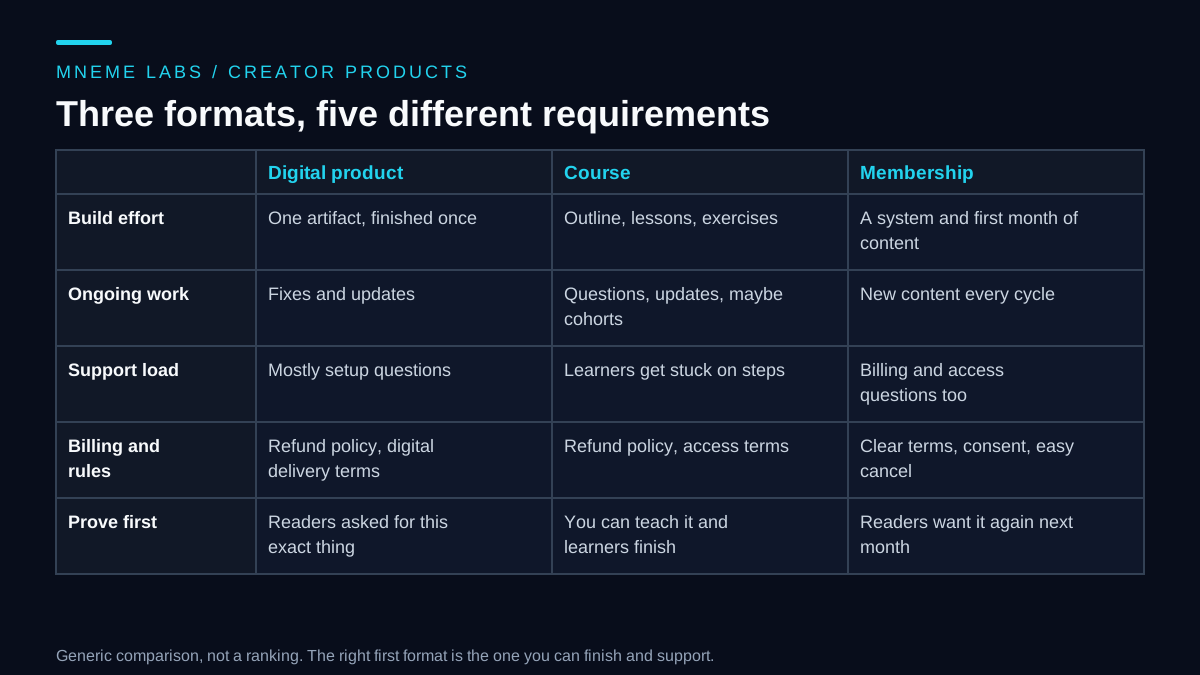
What each format actually requires
A digital product is a template, guide, spreadsheet or toolkit. You build it once and deliver it by download. The work after launch is small but real: fixing errors, answering setup questions, and handling refund requests. The thing to prove first is that readers asked for this exact thing, not just a topic near it. For the baking example, a reader who writes "how do I keep my starter alive while traveling" is asking for a specific artifact, such as a one-page schedule.
A course teaches a skill from start to finish. It needs an outline, lessons, exercises, and some way for learners to know they succeeded. The hard part is not producing text. It is knowing where learners get stuck, which only comes from teaching real people. If you have never watched someone follow your method, you do not yet know if the course works. A live workshop for a small group is a cheaper test than recording a full course.
A membership sells access over time. Members expect fresh content, a community, or direct access to you, and they expect it every cycle. The cost is mostly your time each month, plus billing operations such as failed cards, cancellations and access control. The thing to prove first is that people want it again next month, not just once.
A rough rule follows from this. The more ongoing delivery a format needs, the more evidence of repeat demand you want before launching it. A product can be an experiment. A membership is a commitment.
Where AI helps and where it does not
Models help most with work that is slow because it is tedious.
- Grouping audience questions. Paste anonymized comments or emails and ask for topic groups with counts. Then check the groups against the raw messages yourself, because a model can merge two different problems into one theme.
- Outlining. A first outline gives you something to react to. Cut and reorder it using what you know learners find hard.
- Cleaning transcripts. If you teach on video, a model can turn a rough transcript into readable lesson notes. Check technical steps against what you actually do.
- Drafting exercises and quiz questions. Treat them as drafts and try each one yourself.
- Checking consistency. Ask whether lesson three uses a term before lesson two defines it.
Models do not replace the experience. A course made of text that nobody on the team has tested is a collection of plausible instructions. Sales copy that claims "learners got X" needs real learners. Do not publish testimonials, results or student counts unless they are real. The same goes for revenue claims about yourself, which often go unchecked and mislead buyers.
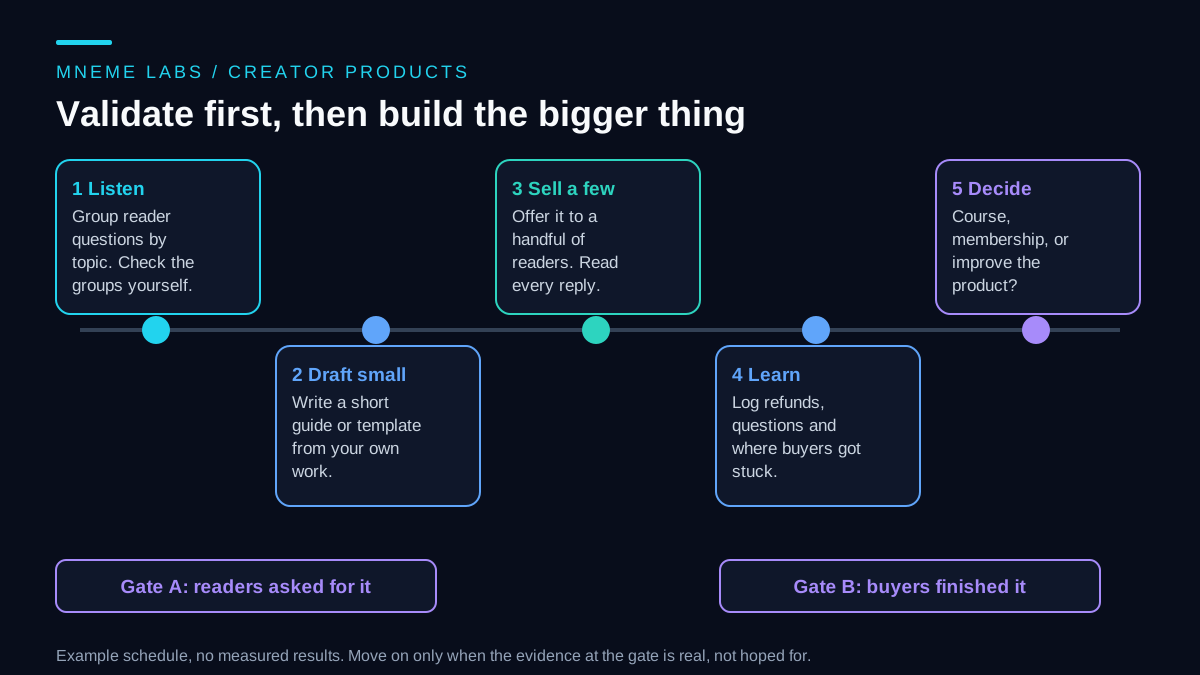
A validate-first path
The path below is an example schedule with decision gates, not a promise of timing or sales.
- Listen. Collect reader questions for a few weeks. Group them by topic and check the groups by hand.
- Draft small. Pick the most repeated question and write a short product that answers it, using your own work.
- Sell a few. Offer it to a small number of readers and read every reply.
- Learn. Keep a log of refunds, questions, and where buyers got stuck.
- Decide. Choose between a course (if buyers want to learn more and finish what they start), a membership (if they keep asking for new material), or an improved version of the same product.
Presales deserve care. Selling something before it exists can work when you say clearly what will be delivered and when, and then deliver it. It goes wrong when the description promises more than you can finish. If you presell, write the scope down, set a realistic date, and have a plan for refunds if you miss it.
Do the math on your own time
Before building a membership, estimate what it costs you each month and how many paying members cover that. The function below is a plain Python sketch. Every input is an assumption that you supply, and the fees are placeholders you replace with your payment provider's published rates.
import math


def members_needed(price, fee_pct, fee_fixed, monthly_hours, hourly_value, fixed_costs):
    """Paying members needed per month to cover your delivery time and tool costs."""
    net_per_member = price * (1 - fee_pct) - fee_fixed
    if net_per_member <= 0:
        raise ValueError("price does not cover per-payment fees")
    cost = monthly_hours * hourly_value + fixed_costs
    return math.ceil(cost / net_per_member)


def replacement_per_month(members, monthly_churn):
    """New members needed each month just to stay level, given monthly churn (fraction)."""
    return members * monthly_churn
With synthetic inputs of a 20 dollar monthly price, a 3 percent plus 0.30 per-payment fee, 10 hours of monthly delivery valued at 40 dollars an hour, and 60 dollars of tools, the sketch returns 25 members. At an assumed 8 percent monthly churn, those 25 members mean about two new members every month just to stand still. The assertions in the test file confirm those two numbers and the guard that rejects a price too low to cover fees. None of the inputs come from a real business.
The calculation shows why memberships are often harder than they look. Your time is the biggest cost, and churn means you keep recruiting to stay level. If you cannot say where the next two members each month will come from, the plan has a gap that no amount of generated content will close.
Refunds, cancellation and billing rules
Each format has its own obligations. These are starting points to check, not legal advice, and the rules depend on where you and your buyers are.
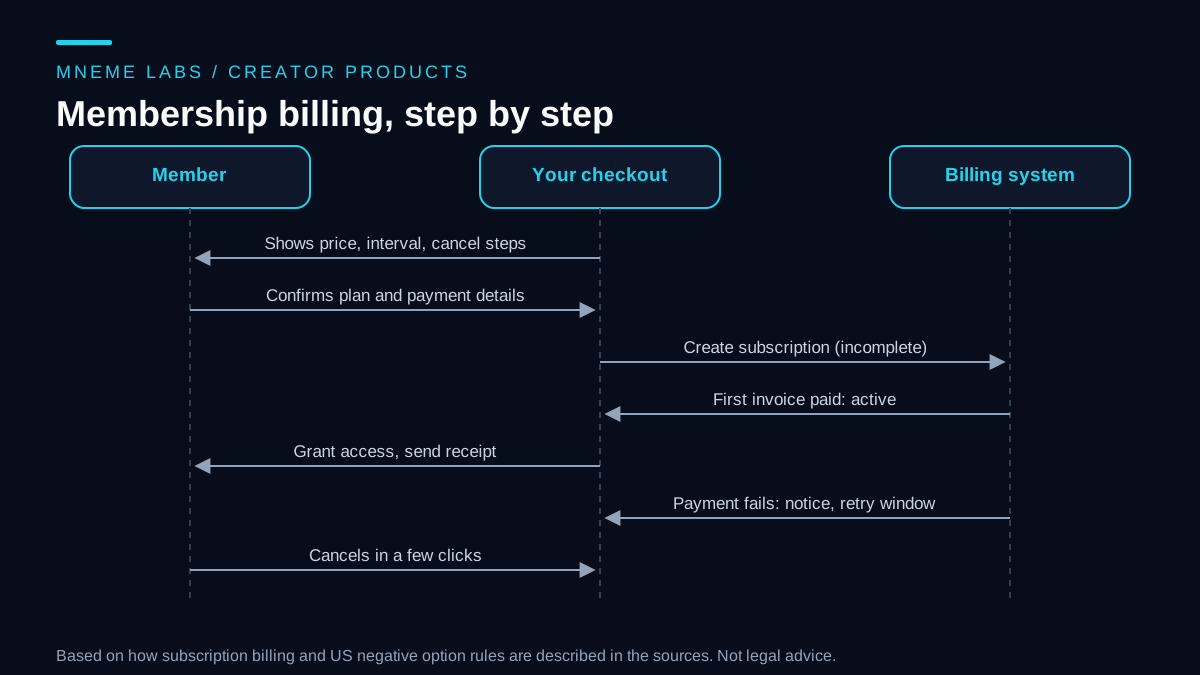
Recurring billing in the US. The statute on negative option marketing on the Internet, 15 U.S.C. 8403, makes it unlawful to charge a consumer through a negative option feature online unless you clearly and conspicuously disclose all material terms before getting billing information, obtain express informed consent before charging, and provide simple mechanisms to stop recurring charges. In practice, that means the checkout page should show the price, the billing interval and how to cancel before asking for payment details, and the cancel path should be easy to find. The statute refers to a rule definition for what counts as a negative option feature, so a lawyer can tell you whether your offer falls under it.
Withdrawal rights in the EU. The European Union's Your Europe guidance on returns says consumers buying online generally have a 14-day cooling-off period, with listed exceptions. One is online digital content that the buyer began downloading or streaming after expressly agreeing to lose the right of withdrawal. Another is a fully delivered service where the buyer expressly agreed to start immediately and acknowledged losing the right. So the wording and the moment of consent at checkout matter. National rules differ in details.
Billing operations. Stripe's documentation on how subscriptions work is one concrete example of the lifecycle. A new subscription starts as incomplete and becomes active after the customer pays the first invoice. The page also says Stripe handles payment retry logic and dunning, and suggests using webhook events to track status changes so you know when to provision access and when to notify customers. Other billing tools work differently, so read yours. The point is that "someone is a member" is a state that changes, and your content access should follow the billing state, not a spreadsheet you update by hand.
Failure cases to plan for
Building before asking. The course is finished and nobody wants that topic. Gate A in the path above exists to prevent this.
The empty content calendar. A membership launched with one month of material runs out. Decide your delivery schedule from the hours you can really spare, and cut it if the first month felt heavy.
Generated material with errors. A template that contains a wrong formula or a lesson with an unsafe or incorrect step hurts buyers. Test every product the way a buyer would use it. For anything involving health, money or safety, add expert review.
Refund and cancellation friction. Hard-to-find cancellation causes disputes and may also break rules. Make it simple, and handle refunds quickly and politely.
Support piling up. A product that sells well can still bury you in email. Write an FAQ from real questions, and let a model draft replies that you approve until patterns settle.
Limits
This is a comparison, not a forecast. It cannot tell you which format suits your audience, only what each demands. The break-even sketch ignores taxes, refunds, platform costs beyond a flat fee, and the cost of finding new buyers. Legal requirements vary, and the sources above describe general rules, so a short consultation with a lawyer or accountant in your area is worth the cost before you launch recurring billing.
Next step
Take your last month of reader questions and group them. Pick the single most repeated question and write the smallest product that answers it. Sell it to a few readers, keep notes, and decide at the second gate whether the evidence points to a course, a membership or a better product. If you want help turning questions into topics, the idea backlog guide shows a way to organize them.
Sources
- 15 U.S.C. 8403, Negative option marketing on the Internet: disclosure of material terms before billing information, express informed consent, simple way to stop recurring charges.
- Your Europe, Returns and the right of withdrawal: 14-day cooling-off period and exceptions for digital content and fully delivered services when the buyer expressly agrees.
- Stripe, How subscriptions work: subscription lifecycle, incomplete to active status, payment retry and dunning handling, webhook events.